How Do We Know When Morning Has Begun?

 
How Do We Know When Morning Has Begun?
 

How Do We Know When Morning Has Begun?


This week marked the fiftieth anniversary of the assassination of the Rev. Dr. Martin Luther King. I was reminded of what a profound impact that event had on my then twelve-year-old self when I attended an interfaith gathering to honor Dr. King’s legacy this week. At the gathering, Rabbi Noah Chertkoff, Imam Yaseen Masjid Al-Rahman, and the Rev. Dr. John Walton took turns speaking of the need for each of us to continue the work of fighting against racism in all of its forms, work that was only just beginning when Dr. King’s life was tragically cut short.  Each of the speakers drew from the wisdom of their own faith tradition and each shared stories and ideas that were memorable.

I continue to think about the wisdom that each speaker shared, and there is one story, told by Rabbi Chertkoff, that has stayed with me and I would like to share it with you. In ancient days a rabbi gathered his students together just before dawn and asked them a question: “How does one know the exact moment when night has ended and morning has begun?” The first student replied, “When I can look out and see the point at where my farm field ends and my neighbor’s begins, that is when morning as begun.” A second student answered, “When I can look out and can make out the shape of my neighbor’s house from my own, that is when morning begins.” The rabbi smiled but shook his head indicating these answers were not correct.

The last student offered, “When I can look out in my field and can tell the difference between a horse and cow, then morning has arrived.” At this point, the rabbi spoke, “Each of you is mistaken because you have all focussed on division and how you know morning has come when you are able to divide and separate one thing from another. I am here to tell you that at the very moment when you can look at every man and woman regardless of their race, creed, or color and see them as your brother or sister—that is when the night has ended and morning has begun.”

What a beautiful old story and a reminder for all of us that focusing on what divides and separates us is not how new light comes into the world. It is instead when we can see that we are all brothers and sisters that a new day can be born. As we sat together this week honoring Dr. King, Christians, Jews, and Muslims, I had a glimpse of how the higher moral truths that he spoke of do indeed have the ability to unite us, offering genuine hope for a new morning.


Subscribe Now to Weekly Words of Wellness:

Click the button below to signup for the e-mail version of Weekly Words of Wellness. This weekly article can be shared with your community electronically and/or used for group discussion.

You can unsubscribe at any time.

The Ground Begins to Soften

 
Weekly Words of Wellness
 

The Ground Begins to Soften

   For those of us who celebrate Easter in the northern hemisphere, we are blessed to have abundant symbols of resurrection and rebirth all around us. We are blessed to enjoy the new buds on the trees, the return of birds that have been south for the winter, the lengthening of the days, and the overall warming temperatures.  For me, though, there is one sign in nature that is the most meaningful indicator of new life this time of year, one that is probably easy to overlook...the ground begins to soften.

   First, the snow melts, and then gradually the ground that has been frozen and covered all winter begins to thaw and soften. One thing I love about the ground starting to soften is that I am able to move my  runs off the concrete sidewalks and onto the soft earth, which provides welcome cushioning to my aging joints. Softening ground is wet ground this time of year, and I love the squishing sound that my shoes make with every step I take. The softer ground also means that soccer and baseball games will soon be played again, and that those with green thumbs will soon be digging in their gardens.  The softer earth gives rise to so many beautiful stirrings of new life.

   As we celebrate Easter this weekend, we are not just  celebrating something that happened almost 2000 years ago; we are also celebrating the truth that God continues to make things new, that God continues to bring life out of death. The image of the ground beginning to soften is a vivid metaphor of what it feels like when God is doing a new thing in our lives.

   I know this feeling in my own life, and I see it in my work as a minister and a therapist. People usually come to see me because life has become hard for them, literally. They come in with hearts, minds, souls and even bodies that have become hardened and rigid. They come alone, or they come with their loved one, or they bring their whole family because everyone has become hardened to each other. This hardness is usually the result of frozen sadness or hurt, or unresolved conflict or grief and the hardness has built up over a long period of time.

   Why have they come? Because deep down, they don't want to be hard-hearted, hard-minded, or hard-spirited, towards themselves or towards the people they love most. Deep down, a small, still voice longs for something different. And because they are willing to listen to this longing, slowly, imperceptibly at first, a miracle begins to happen. The ground begins to soften. The softening heart/mind/soul, just like the softening earth, soon gives rise to all kinds of miraculous new life. People forgive each other, and they forgive themselves. People who haven't done so for a long time touch and hug again. There is laughter where once there was criticism and hurt. There is joy where there once was shame and guilt. Grief gradually loosens its grip. There is freedom where there once was bondage. There is life where there once was death. Resurrection happens. There is always a risk in the process of softening and choosing resurrection, but it is always worth it.  

   We at Living Compass wish all of you a Happy Easter.  May your hearts and souls be softened today by the presence of the One who continues to bring life out of death.


Subscribe Now to Weekly Words of Wellness:

Click the button below to signup for the e-mail version of Weekly Words of Wellness. This weekly article can be shared with your community electronically and/or used for group discussion.

You can unsubscribe at any time.
The Importance of Rituals

 
Weekly Words of Wellness
 

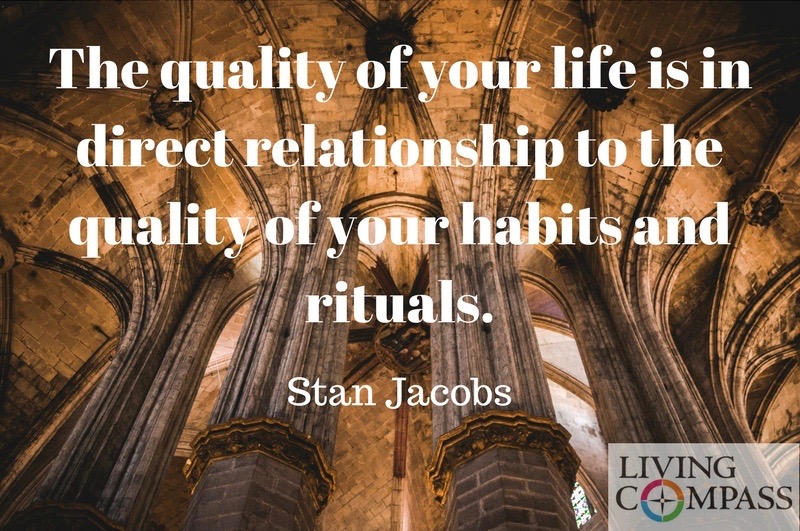
   We had the joy of staying with our grandkids recently for an overnight and probably the most important instructions we received before the parents left had to do with bedtime rituals. Every family with young children has them, and as with all rituals, their power comes from their familiarity, order, and repetition.  

   Rituals are essential for ordering our families, friendships, work, play, and personal lives. They help form our identities, both individually and communally.  Rituals are how we pass on wisdom and beliefs across generations. All societies have their rituals, and of course, so do all religions.

   During the next two weeks, both Jews and Christians will celebrate some of the most sacred rituals of their respective faith traditions. Holy Week begins this coming Sunday for Christians and culminates with the celebration of Easter the following Sunday.  Passover starts next Friday and continues for the following eight days. Each sacred ritual will draw on ancient traditions. Stories will be told. Songs will be sung. Prayers will be offered. Faith will be renewed. Community bonds will be strengthened.
 
   All families have rituals that make them unique. Family rituals are common around the sharing of meals, bedtime routines, celebrating holidays, enjoying vacations, recreating, and participating in spiritual/religious celebrations. Family rituals embody values and core beliefs that are important to each family and help ground and form the identities of the members of the family. What family rituals have been important in your life?  Are there family rituals that have been passed on through the generations? What do they say about your values and those of your family?
 
   For many years, when our children were young, I would make pancakes every Saturday morning. Blueberry pancakes were a favorite, as were pancakes shaped in the form of each child's initials. The family time around the breakfast table was every bit as important as the meal we shared as it provided a chance to hear about each others' week and to talk about plans for the upcoming weekend.This simple ritual, among many others, helped ground and bond our family together.
 
   The important ingredient in participating in rituals, whether family or religious, is how we choose to participate. How we show up makes all the difference. Choosing to be mindful and fully present means that we will both receive the most from and give the most to the experience. If, however, we are distracted, merely going through the motions of a ritual, we will likely receive little and give little to the experience and to those who are participating with us.
 
   As many of us prepare to celebrate the sacred rituals of our particular faiths, may it be a time for us to also remember the importance of the sacred rituals of our daily lives spent with family and friends. And whether we find ourselves making blueberry pancakes for our family, telling a favorite bedtime story, or attending religious services may we do so joyfully and mindfully, choosing to bring our full selves to these most important and defining experiences.


Subscribe Now to Weekly Words of Wellness:

Click the button below to signup for the e-mail version of Weekly Words of Wellness. This weekly article can be shared with your community electronically and/or used for group discussion.

You can unsubscribe at any time.

The Shelter of Each Other

Weekly Words of Wellness

In honor of St. Patrick’s Day, here are a few of my favorite Irish sayings: May the wind be always at your back.

May you have the hindsight to know where you’ve been, the foresight to know where you are going, and the insight to know when you have gone too far.

You’ve got to do your own growing, no matter how tall your parents were

A good laugh and a long sleep are the two best cures.

It’s easy to halve the potato where there’s love.

A little fire that warms is better than a big fire that burns.

Your feet will bring you where your heart is.

You’ll never plow a field by turning it over in your mind.

And here’s my favorite one of all:

It is in the shelter of each other that the people live.

There are many ways we can provide for one another the kind of shelter this favorite saying of mine describes. We can provide shelter by genuinely listening to one another, or by just being present to a person, not trying to change or fix them.  We can also provide shelter to each other by simply offering any or all of the following: compassion, love, patience, forgiveness, acceptance, and gratitude. It’s as easy as that, and as hard as that.

In addition to their witty sayings and proverbs, the Irish are also well known for their collection of blessings.  Type “Irish Blessing” in a Google search, and you will find hundreds of examples.  Even if you are not Irish yourself, you likely are already familiar with several of these blessings. Offering someone your blessing is another way we can provide emotional and spiritual shelter for them to live within.

One way I know about a blessing’s power to provide shelter is because of how many times I have heard stories about the opposite, when a blessing is withheld.  In my counseling work, I have heard stories of great sadness when a person shared how a significant person in their life—a parent, grandparent, boss, close friend—did not bless the person they were or an important decision they had made.  “It has always been painful for me that I did hot have my _______’s blessing,”  is almost always said with tears in their eyes.

On the other hand, something very different happens when a person tells a story of how much it means to them to have received the blessing of a significant person in their life.  Their eyes sparkle with joy, and their face lights up as they share their story of being blessed.  To be blessed by someone is to experience the shelter of their unconditional love and positive regard.  It means they have our back and want the best for us.

There are indeed many ways to recognize St. Patrick’s Day.  This year, I invite you to join me in celebrating it by remembering to be a blessing, and to offer freely and regularly our blessings to friends, families, and neighbors.

I also invite you to share your favorite Irish saying or blessing with me by replying to this email.

Now I close with one beautiful Irish blessing, one that speaks to the many kinds of shelter we  can, in fact, offer to one another when we are generous and loving

May you always have

Walls for the winds

A roof for the rain

Tea beside the fire

Laughter to cheer you

Those you love near you

And all your heart might desire.


Subscribe Now to Weekly Words of Wellness:

Click the button below to signup for the e-mail version of Weekly Words of Wellness. This weekly article can be shared with your community electronically and/or used for group discussion.

You can unsubscribe at any time.
Loving Well

 
Weekly Words of Wellness
 

This week I am sharing some material I wrote for the Living Compass booklet of daily readings entitled Living Well Through Lent 2018. The theme of this booklets is “Loving With All Your Heart, Soul, Strength, and Mind.”  

*     *     *     *     *     *     *     *     *     *     *

It seems that frequently when the topic of love is discussed, the discussion often turns to the idea of falling in love, the great wonder that exists when love is new.  As a culture, we primarily focus on and celebrate the “falling in love” stage of a relationship, be it the love of a new couple, the birth of a new child, or the formation of a new friendship. If a person knew nothing else about love except what the media portrays, one would think that falling in love must be what is most important. Anyone who has been in love, of course, knows differently.

The head over heals rush of falling in love, as powerful and wonderful as it is, is transitory. So given the fact that falling in love is such a small phase of any relationship, it seems wise to reflect on the importance of what comes after falling in love, and that is learning to stand in love. Standing in love is an extension of the idea that love is not only a feeling, but is also a decision.  Regardless of what we may or may not be feeling, we can decide to stand in love in any relationship and to work with that person long after the feelings of falling love have diminished.

When a friend or family member cares for a chronically ill loved one, they are standing in love. When a person faces down their fear and stands up to racism, that person is standing in love. When a person refuses to give up on someone they love who is struggling with an addiction or other adversity, they are standing in love.

Few things reflect the state of our own spiritual and emotional wellness than our capacity to love well, and so it is wise to think about this as it applies to your own life from time to time. I know that when I am in an internal state of worry and negativity, my capacity to love others is greatly diminished. When I am in a place of internal peace and calm, I  have a much greater capacity to both feel and express love.

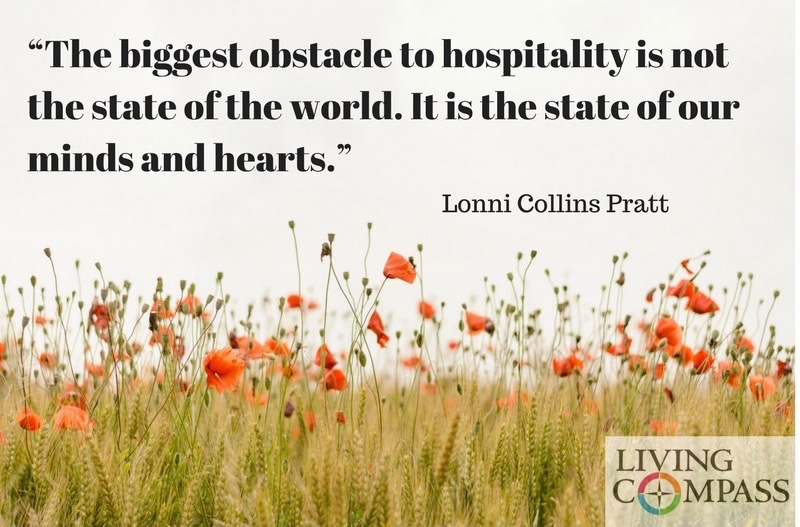
I recently facilitated a Parent Wellness Circle, a six-week gathering of parents who are meeting to become more intentional about their parenting. In one discussion the parents agreed that almost every time they had been harsh with their child, it was more of a reflection of what was going on inside of them, rather than what their child had been doing or not doing, that triggered their reaction. When they were not in a good place themselves, it was hard to be a patient and loving parent. Lonni Collins Pratt says it best in her book Benedict’s Way: Making Room for Love, “The biggest obstacle to hospitality is not the state of the world. It is the state of our minds and hearts.”

Do you see a connection between your own emotional and spiritual wellness and your capacity to love others? Do you see any “obstacles to hospitality” in your own mind or heart? If so, what might you do to remove them?


SUBSCRIBE NOW TO WEEKLY WORDS OF WELLNESS:

Click the button below to signup for the e-mail version of Weekly Words of Wellness. This weekly article can be shared with your community electronically and/or used for group discussion.

You can unsubscribe at any time.