"This Precious Summer," May 22, 2026


The Wellness Compass Initiative is our partner community wellness initative that serves schools, counseling centers, nonprofits, universities, and other community wellness organizations. Each week Holly Hughes Stoner and Scott Stoner, who are both licensed marriage and family therapists, co- write a column for Wellness Compass and we are pleased to share it here on our Living Compass site. There is also a Wellness Compass podcast, where Scott and Holly elaborate on the topic of this column each week, at www.wellnesscompass.org/podcast. or in any podcast app (Apple, Google, Spotify, etc).

This Precious Summer

In honor of this being our last column of the season — we will be taking the summer off to rest and renew — we would like to share one of our favorite poems with you. We hope this will inspire you as it has us.

If you prefer to listen to this poem read by the author herself, click HERE.

"The Summer Day" by Mary Oliver

Who made the world?

Who made the swan, and the black bear?

Who made the grasshopper?

This grasshopper, I mean — the one who has flung herself out of the grass,

the one who is eating sugar out of my hand,

who is moving her jaws back and forth instead of up and down

— who is gazing around with her enormous and complicated eyes.

Now she lifts her pale forearms and thoroughly washes her face.

Now she snaps her wings open, and floats away.

I don't know exactly what a prayer is.

I do know how to pay attention,

how to fall down into the grass,

how to kneel down in the grass,

how to be idle and blessed,

how to stroll through the fields,

which is what I have been doing all day.

Tell me, what else should I have done?

Doesn't everything die at last, and too soon?

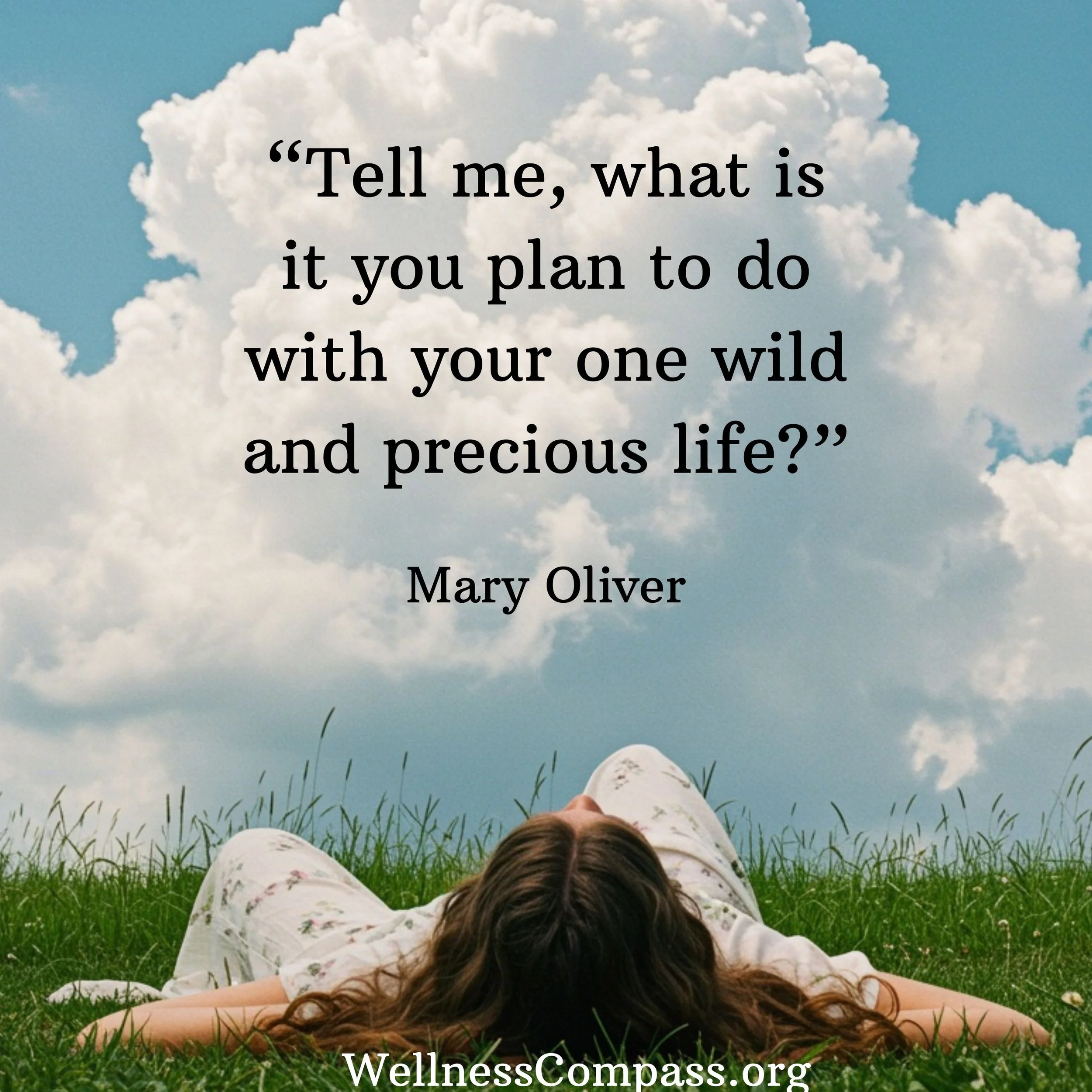
Tell me, what is it you plan to do with your one wild and precious life?

We find the specificity of Mary Oliver's attention to this grasshopper inspiring. It seems to us an invitation to ask, “what will we pay attention to this summer?”

Specifically, how will we pay attention to the moments when we are working in the garden, the sunsets we will see, the smell of flowers we will breathe in, the taste of fresh produce from our farmers markets, the beauty of starlit skies, a possible round of golf on a warm sunny day, the moments when we get to chase fireflies with children or play with them in the swimming pool, watching children running freely through the sprinkler, a marshmallow toasted over a campfire, or the walks we will enjoy on a summer evening?

The ample pleasures of summer invite us to pay attention, to fall down into the grass, to be idle and blessed, and to stroll through the fields.

If the question Mary Oliver ends her poem with seems too immense, perhaps we can whittle it down to this:

What is it you plan to do with this wild and precious summer?

Best to you during the magical time of summer.  May you enjoy its splendors. And we will see you again right after Labor Day.

Warmly, Holly and Scott Stoner


Subscribe Now to Weekly Words of Wellness:

Click the button below to signup for the e-mail version of Weekly Words of Wellness. This weekly article can be shared with your community electronically and/or used for group discussion.

You can unsubscribe at any time.
"Take Me Out to the Slow Game," May 8, 2026


The Wellness Compass Initiative is our partner community wellness initative that serves schools, counseling centers, nonprofits, universities, and other community wellness organizations. Each week Holly Hughes Stoner and Scott Stoner, who are both licensed marriage and family therapists, co- write a column for Wellness Compass and we are pleased to share it here on our Living Compass site. There is also a Wellness Compass podcast, where Scott and Holly elaborate on the topic of this column each week, at www.wellnesscompass.org/podcast. or in any podcast app (Apple, Google, Spotify, etc).

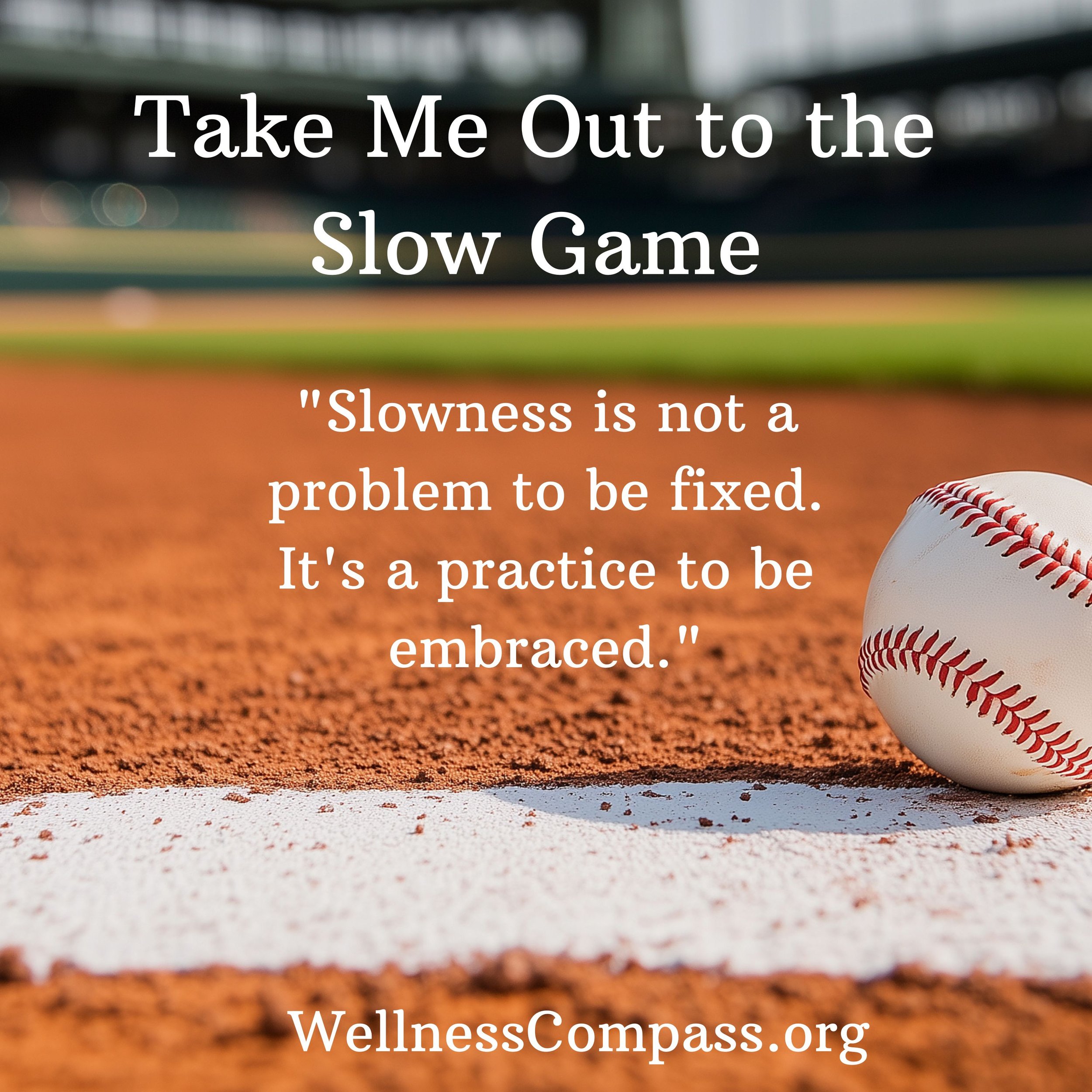
Take Me Out to the Slow Game

“Baseball is too slow for me—I prefer sports like basketball with its constant action and scoring” is a comment we overheard at our grandson’s Little League game this week. Because it wasn’t said directly to us, we didn’t have the opportunity to respond with all the ways we love the slow pace of baseball. We’d like to share those with you now, and because this is a wellness column, we can’t resist the opportunity to reflect on what the slowness of baseball has to teach us.

First on the list would have probably been that we love the game just because it is slow. Even with the advent of the pitch clock and a few other changes to speed up the game for our impatient culture, the game still has a refreshing pace that allows you to savor each pitch, each at bat, and each play in the field. The pace allows you to pause long enough to wonder, “Should they bring the infield in?” or “Is this a good time to hit and run?” or “Should the outfield be playing this batter to pull?” or “The pitcher has thrown three consecutive four-seam fastballs—so is it time to throw a circle change?”

The opinion that baseball is too slow has been voiced more frequently over the last few decades. Perhaps a different way to frame that perception is that life by contrast has increasingly sped up and maybe even become too fast.

Baseball is a celebration of slowness. It resonates with the slow food movement and the increased interest in slow travel. Within medicine there is even a new movement called slow medicine, which is pushing back on the limitations of the five to seven minute office visits.

Speaking of medicine, Scott tried something very counter-cultural (and counter-intuitive for him) this week. He had a doctor’s appointment and his doctor was running late so he had a half hour to himself in the waiting room. Because he was thinking about this concept of patience and slowing down, he resisted getting his phone out and checking the news or his email or …. last night’s box scores.  He sat for a full thirty minutes without reaching for his phone. He took some deep breaths and practiced some mindfulness meditation. When he returned home he was embarrassed to report that this was not easy for him to do. Like the woman we overheard at our grandson’s baseball game, he, too, sometimes craves action and stimulation.

Life has its own series of waiting rooms. Waiting for clarity on a difficult issue. Waiting for a loved one to find their way. Waiting for healing. Waiting for peace. We long for progress and some kind of action that will bring quick resolution. When we can’t just scroll ahead we are invited to enter into the wisdom of slowness and the practice of patience.

Three thousand years ago the author of the book of Ecclesiastes gave us this hopeful wisdom, “There is a time for everything, and a season for every activity under the heavens.”

May we find the grace to trust the season we are in and to patiently embrace the waiting and unfolding, even when we wish things would move a little faster.

And may we watch a few games of baseball to remind us of the benefits of slowing down.


Subscribe Now to Weekly Words of Wellness:

Click the button below to signup for the e-mail version of Weekly Words of Wellness. This weekly article can be shared with your community electronically and/or used for group discussion.

You can unsubscribe at any time.
"Sharing Awe: What 19,000 Likes Can Teach Us About Supporting One Another's Mental Health," April 24, 2026


The Wellness Compass Initiative is our partner community wellness initative that serves schools, counseling centers, nonprofits, universities, and other community wellness organizations. Each week Holly Hughes Stoner and Scott Stoner, who are both licensed marriage and family therapists, co- write a column for Wellness Compass and we are pleased to share it here on our Living Compass site. There is also a Wellness Compass podcast, where Scott and Holly elaborate on the topic of this column each week, at www.wellnesscompass.org/podcast. or in any podcast app (Apple, Google, Spotify, etc).

Sharing Awe: What 19,000 Likes Can Teach Us About Supporting One Another's Mental Health

Something unexpected happened after we published our last Wellness Compass column about the Artemis II mission. Nearly 7,000 people shared it, and almost 19,000 offered a "like." We weren't expecting that. We've been sitting with it ever since, asking: what does that response tell us?

We think it's data. Specifically, it's data about how hungry we are — as individuals, as a culture — for good news. For wonder. For awe. For something that lifts our eyes above the noise.

And it turns out our hunches are well supported by recent research on awe.

Dr. Dacher Keltner, professor of psychology at UC Berkeley and founding director of the Greater Good Science Center, has spent decades studying the emotion of awe. He explores these findings in his 2023 book, Awe: The New Science of Everyday Wonder and How It Can Transform Your Life. He defines awe simply as "the feeling of being in the presence of something vast that transcends your current understanding of the world." His research shows that awe isn't just a pleasant feeling — it's a powerful force for mental and physical health.

Artemis II gave millions of people an experience of awe and wonder. Four astronauts flew farther from Earth than any humans had before. They looked back at our planet — this fragile, luminous sphere — and reported a sense of unity, of smallness, of profound beauty. And through the miracle of live coverage, they took us all along for the journey.

Keltner also writes that "tears arise when we perceive vast things that unite us into community.” That was certainly our experience. The shares and likes of our column weren't just people saying they enjoyed an article. They were people passing along a feeling—offering their friends and family a gift, a witness to awe. Experiences of awe and wonder long to be shared and when we do we strengthen our connections with others.

This matters for mental health in a very practical way. Most of us can't fly to the moon. But Keltner's research makes clear that awe is not reserved for astronauts or mountaintops. It is present in daily life, in the sighting of the first spring robin, a kind gesture, a powerful line in a book, a moment of prayer or stillness. It lives in music, in nature, in witnessing acts of moral courage.

Keltner identifies eight distinct wonders of life that can open us to awe:

Moral Beauty: Witnessing others' kindness, acts of courage, overcoming obstacles, and rare talents inspires awe.

Collective Effervescence: Moving in unison stirs the human waves of awe felt within ritual, sport, dance, religion, and public life.

Nature: Immersion in nature and its divinely "wild awe" become spiritual and heals bodies and minds.

Music: Musical awe embraces us as participants and promotes its shared experience and a sense of community.

Visual Design: Visual design and "sacred geometries" help us understand the wonders of life.

Spirituality and Religion: Our spiritual life and religious beliefs—"the fundamental it"—grow out of mystical awe.

Life and Death: Awe helps us understand the cycle of life and death, from childbirth to bearing witness to, yet not knowing what is dying.

Epiphany: Awe allows us to recognize we are part of systems larger than the self: interrelated elements working to achieve a purpose.

The list is both surprising and reassuring — most of these are available to us every single day. Even a few deliberate minutes outdoors, or pausing to notice something beautiful, can be enough to shift our nervous system.

The response to the Artemis column reminded us that people are not, at their core, drawn only to outrage and despair. We are also drawn — powerfully drawn — toward wonder, toward beauty, toward one another. That impulse, the science now confirms, is one of the most life-giving forces we have. Let's keep seeking it and sharing it.


Subscribe Now to Weekly Words of Wellness:

Click the button below to signup for the e-mail version of Weekly Words of Wellness. This weekly article can be shared with your community electronically and/or used for group discussion.

You can unsubscribe at any time.
"What Artemis II Can Teach Us About Mental Health," April 10, 2026


The Wellness Compass Initiative is our partner community wellness initative that serves schools, counseling centers, nonprofits, universities, and other community wellness organizations. Each week Holly Hughes Stoner and Scott Stoner, who are both licensed marriage and family therapists, co- write a column for Wellness Compass and we are pleased to share it here on our Living Compass site. There is also a Wellness Compass podcast, where Scott and Holly elaborate on the topic of this column each week, at www.wellnesscompass.org/podcast. or in any podcast app (Apple, Google, Spotify, etc).

What Artemis II Can Teach Us About Mental Health

On our Wellness Compass podcast this week we talked about how we, as a couple of mental health providers, took away some important lessons from following the outer space journey of Artemis II.

Here, in no particular order, are our takeaways:

There is Power in Expanding Our Perspective. Suppose someone says, "I'm a control freak. I micromanage everything." A helpful reframe you could offer them is: “Sounds like you have high standards and a deep investment in things going well. That care and attention to detail can be a real asset as long as you can find a way to channel it in ways that don't exhaust you or those around you.” The reframe expands the perspective and opens up new ways to see the issue.

Viewing Earth from space is the ultimate reframe—and (please excuse the pun!) a very high level experience of expanding one’s perspective. The expanded perspective from space removes human-made earthly divisions and helps to remind us that we really are all ultimately one, and in this together.

If You Want to Go Far, Go Together. There is a proverb that says, “If you want to go fast, go alone; if you want to go far, go together.” The four astronauts are a diverse group with unique skill sets. The success of the mission is based on their interconnection and interdependence.  Add to this the much larger team of scientists who built the craft and oversee all the other logistics, and you see that we all definitely do better, and go farther, when we work together, in space and here on Earth.

There is a Time for Autopilot and a Time for Taking the Controls. Many things we do in our day-to-day lives are routines that maybe are not fully on autopilot, but we don’t need to give them a lot of new thought each day. However, there are times, either because of disruption in our lives or because we want to move into a new “orbit,” that we need to turn off the autopilot and truly take control, so that we can fly with greater awareness and intention. This is exactly what the astronauts did on their mission. NASA had each crew member take a turn flying the craft so that they would know what to do in case the autopilot function failed and they needed to take control themselves.

Growth Requires Moving Out of Comfort Zones. Could there be a more powerful example of moving out of one’s comfort zone than choosing to fly to outer space? All change and growth, by definition, requires a decision to move out of our comfort zones. As long as we make this move with awareness, intention, and a supportive team of people around us, we maximize our chances of gaining a whole new perspective in our lives. This can open us to experiences and vistas we never thought possible from within our previous comfort zones.

We applaud the courage and success of the Artemis II voyage and all the people who have made it possible. And as we write this the night before they are due to return to Earth, we thank them for the inspiration and wisdom they have offered us and we wish them a safe and successful landing.


Subscribe Now to Weekly Words of Wellness:

Click the button below to signup for the e-mail version of Weekly Words of Wellness. This weekly article can be shared with your community electronically and/or used for group discussion.

You can unsubscribe at any time.
"Only Love Can Do That," March 27, 2026


The Wellness Compass Initiative is our partner community wellness initative that serves schools, counseling centers, nonprofits, universities, and other community wellness organizations. Each week Holly Hughes Stoner and Scott Stoner, who are both licensed marriage and family therapists, co- write a column for Wellness Compass and we are pleased to share it here on our Living Compass site. There is also a Wellness Compass podcast, where Scott and Holly elaborate on the topic of this column each week, at www.wellnesscompass.org/podcast. or in any podcast app (Apple, Google, Spotify, etc).

Only Love Can Do That

Theo of Golden by Allan Levi is the book I (Holly) am currently reading and loving.  Only three quarters of the way through it, the main character Theo and his story has really captivated me as he is everything I’d like to be: curious about others, a good listener to everyone,  generous, and non-judgmental.

I’ve been telling Scott about it all week, sharing many of the stories about Theo’s loving kindness and how I find it to be an  antidote for much of the suffering that is happening in the world.

Like Theo, we believe that love, kindness, and compassion are the most powerful and most essential forces in the world. We find it important to state this, especially at a time when fear and violence are a constant presence.

We talk in our Wellness Compass resources about how there are many compasses that compete to guide our lives. The compasses of the dominant culture are strong, as are the compasses of our upbringings. Choosing spiritual values, as Theo does—like love, kindness, and compassion—to be what guides us toward True North is an intentional choice any of us can make, no matter what other forces may tempt us to follow them instead.

As psychotherapists, we know firsthand the destruction that violence and hatred cause. Having worked with countless clients who have experienced the mind- and soul-crushing effects of violence and hatred, our hearts have been broken more times than we can count. At the same time, being witnesses to the healing power of love and compassion in the lives of people who have suffered has time and time again reminded us that love and compassion are indeed stronger than violence and hatred.

Hatred and violence are ever present in our world, there is no doubt. As Martin Luther King Jr. said, “Hate cannot drive out hate; only love can do that.” That’s why we need to continuously choose love, kindness, and compassion as our enduring values both for our own well-being and the well-being of our world.


Subscribe Now to Weekly Words of Wellness:

Click the button below to signup for the e-mail version of Weekly Words of Wellness. This weekly article can be shared with your community electronically and/or used for group discussion.

You can unsubscribe at any time.