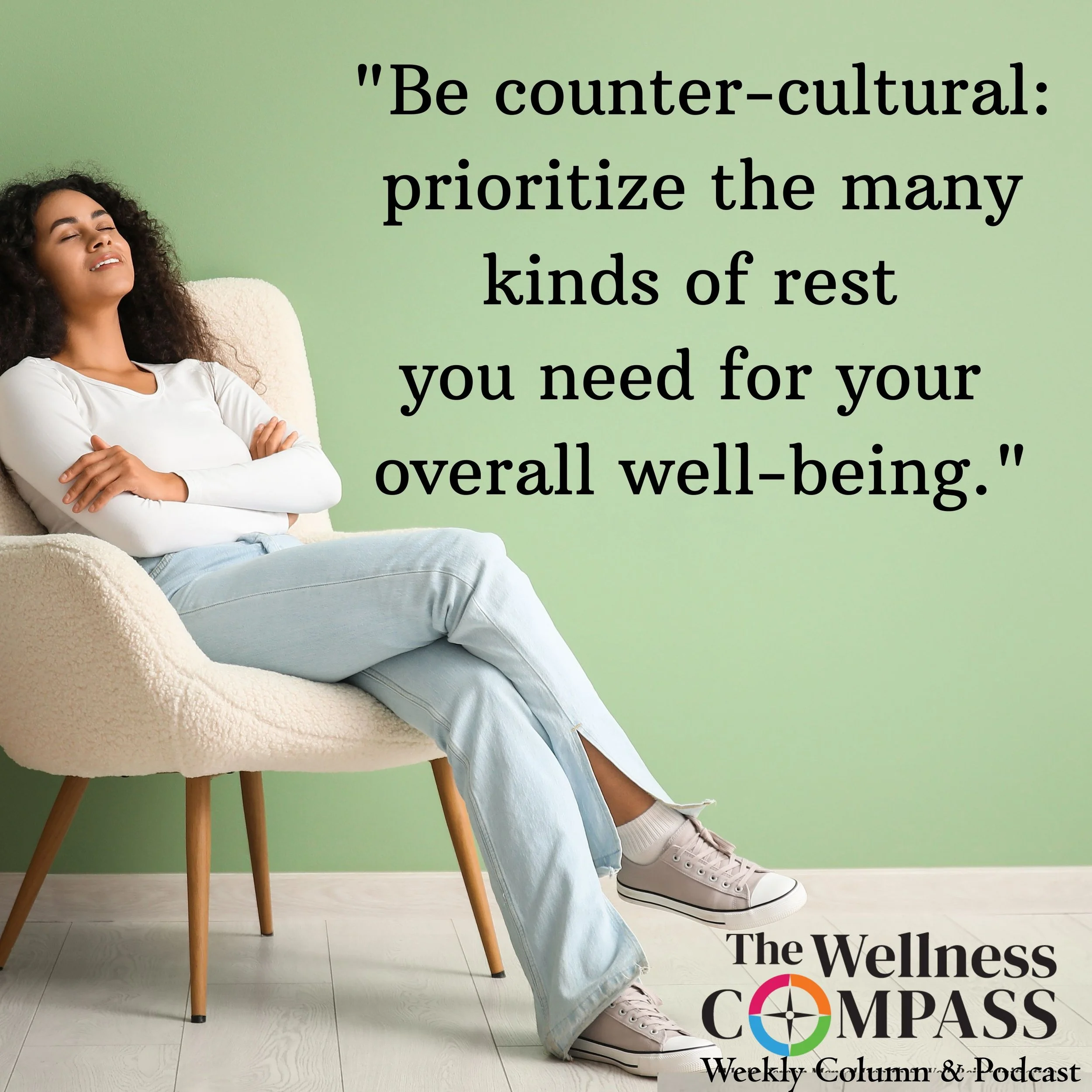
"Our Need for Different Kinds of Rest," October 17, 2025


Our Need for Different Kinds of Rest

The Wellness Compass Initiative is our partner community wellness initative that serves schools, counseling centers, nonprofits, universities, and other community wellness organizations. Each week Holly Hughes Stoner and Scott Stoner, who are both licensed marriage and family therapists, co- write a column for Wellness Compass and we are pleased to share it here on our Living Compass site. There is also a Wellness Compass podcast, where Scott and Holly elaborate on the topic of this column each week, at www.wellnesscompass.org/podcast. or in any podcast app (Apple, Google, Spotify, etc).

Our Wellness Compass Initiative is a holistic approach to wellness. With that in mind, we offer four "Compass Points" that speak to multiple dimensions of rest, as well as help us become aware of our inner attitudes about the role of rest in our lives.

1. Physical Rest: It's not just about enough sleep

There are numerous studies on the connection between various diseases and chronic sleep deprivation. "I'll sleep when I'm dead" takes on a new meaning when we fool ourselves into thinking we can ignore the biological basis of needing adequate sleep. Not getting enough sleep affects our mental health and our relationships, too. Irritability is just one symptom of low sleep. Beyond sleep, we will also benefit from restorative practices that nurture our physical well-being, such as walks (when possible), stretching, and yoga.  We only get one body to live in. Being sure it gets enough rest and renewal is essential to our overall well-being.  

2. Mental Rest: Reducing Cognitive Overload

Our minds process thousands of thoughts daily, and the constant demands of decision-making, problem-solving, and listening to or scrolling through the news of the day can create excessive mental fatigue.  Restorative practices for mental exhaustion can include taking a break from the news for a while, making time for meditation, spending time outdoors in nature, or listening to music. When our mind feels foggy or we struggle to concentrate, we are not being lazy—we are experiencing mental exhaustion that requires rest and renewal.

3. Emotional Rest: Permission to Be Authentic and Practice Self-Care

Two primary causes of emotional exhaustion are caregiving for others and being constantly "on" for others, where we don't feel safe expressing our true feelings; instead, we present a facade. Emotional rest can be found when we can balance caregiving with self-care, recognizing that self-care is not selfish. Rest also comes when we have safe spaces—whether it's with trusted friends or family, or perhaps a therapist — where we can drop our masks and authentically share all our emotions.  

4. Become Aware of Our Mindset Regarding the Importance of Rest 

We live in a culture obsessed with busyness, where we are more like human doings than human beings. It hasn’t always been so. Ancient cultures prioritized the importance of sabbath time. At Wellness Compass, we often discuss becoming more aware of the many compasses that guide our habits and behavior—often outside of our conscious awareness. Busyness and an over-identification with achievement and action are inner compasses that sometimes minimize or even ridicule the importance of rest. Being tired much of the time can even be seen as a badge of honor in many circles.  Therefore, it is essential that we surface our own deeper attitudes about rest and recognize that in our fast-paced world, prioritizing rest and self-care may feel counter-cultural. Making this counter-cultural choice, though, is essential to our overall well-being.  

Making it Personal:

  1. As you read points 1-3, is there an area of rest that could benefit from your attention at this time?

  2. If so, what's one thing you can do in the day or week to experience some rest in that area of wellness?

  3. Reading point 4, are you aware of any attitudes or biases you have about the importance of rest?  


Subscribe Now to Weekly Words of Wellness:

Click the button below to signup for the e-mail version of Weekly Words of Wellness. This weekly article can be shared with your community electronically and/or used for group discussion.

You can unsubscribe at any time.
Sign Up

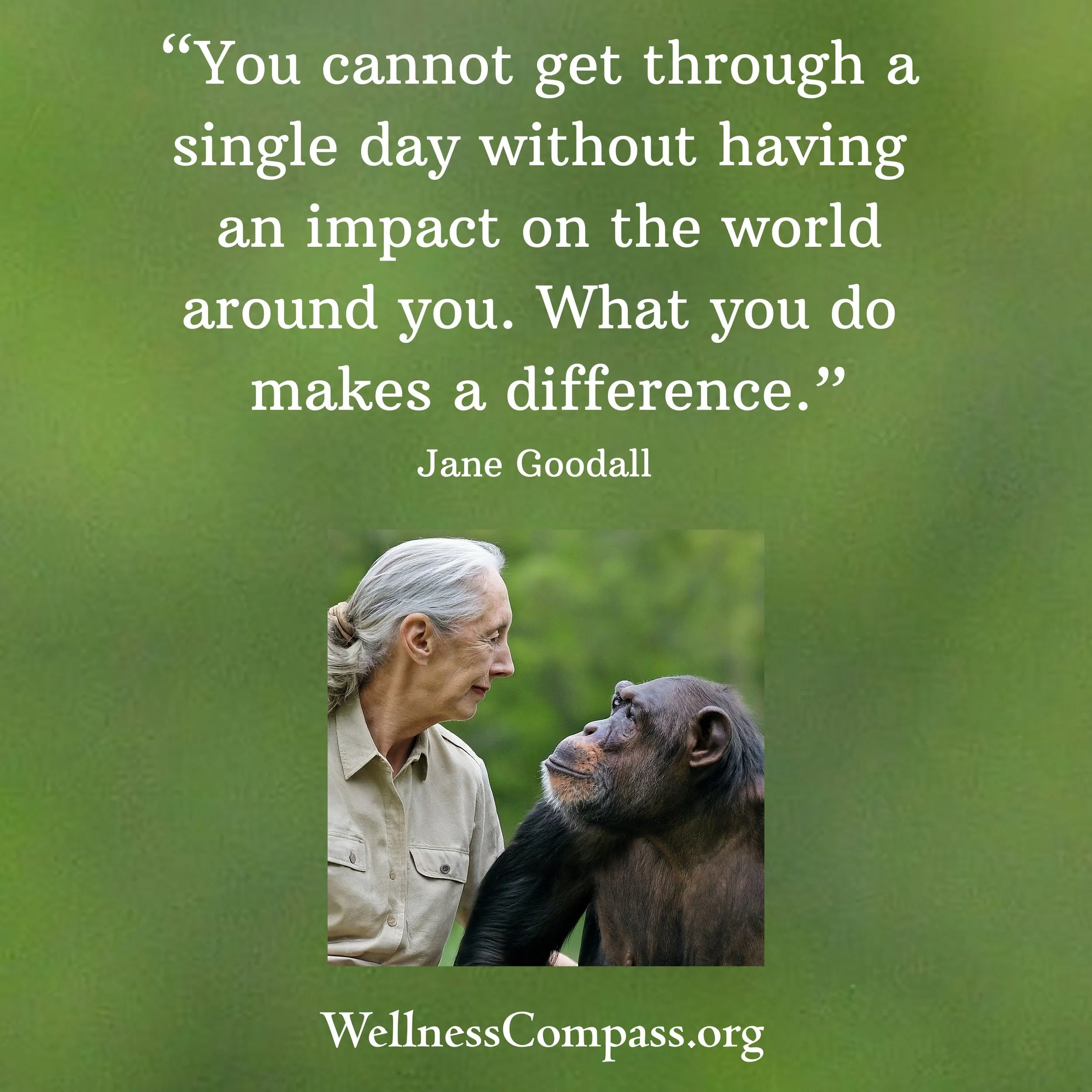
"Four Quotes to Inspire Us From Dr. Jane Goodall," October 3, 2025


A Few Things We Can Learn From Dr. Jane Goodall

The Wellness Compass Initiative is our partner community wellness initative that serves schools, counseling centers, nonprofits, universities, and other community wellness organizations. Each week Holly Hughes Stoner and Scott Stoner, who are both licensed marriage and family therapists, co- write a column for Wellness Compass and we are pleased to share it here on our Living Compass site. There is also a Wellness Compass podcast, where Scott and Holly elaborate on the topic of this column each week, at www.wellnesscompass.org/podcast. or in any podcast app (Apple, Google, Spotify, etc).

Each of our four Wellness Compass Points this week is a quote from scientist Dr. Jane Goodall, who passed away this week at the age of ninety-one. She will be remembered for many things, but probably most often for the way her scientific curiosity and her work with chimpanzees in the forests of Gombe remind us of the interconnectedness of all life. As therapists who think and practice systemically, we are especially grateful for her teachings about how all of life is an interconnected web and that every action we take in the world has a profound impact on all beings. 

1. “The greatest danger to our future is apathy.”

“Am I really making a positive difference in the world?” is a question that any of us may ask ourselves from time to time. There is a lot that needs our attention in our personal and collective lives, and it is easy to feel overwhelmed. The opposite of apathy is hope—not naive optimism, but a disciplined choice to keep showing up as a force for good in the world. 

2. “Lasting change is a series of compromises. And compromise is all right, as long as your values don’t change.”

Too often, compromise is viewed as a sign of weakness.  Remembering that we are all interconnected with all other living organisms helps us realize that compromise is always necessary to achieve the greater good. There is almost always more that unites than divides us. Note that her quote does not ask us to compromise our core values, but to hold true to them with kindness, humility, and respect. None of us possesses all the wisdom. 

3. “What you do makes a difference, and you have to decide what kind of difference you want to make.”

During the pandemic, we wrote about how the question wasn’t Are we contagious?” but rather “What are we contagious with?” Our emotional and spiritual energy is always contagious to those we interact with—either positively or negatively. We all make a difference —the question is, “What kind of difference do we want to make in the world?”.

4. “You cannot get through a single day without having an impact on the world around you. What you do makes a difference.”

Here, Dr. Goodall reminds us always to be aware of the impact our actions and words have on ourselves and those around us. This quote brings to mind two quotes from our Wellness Compass Initiative: “The grass is greener where you water it,” and “Whatever we pay attention to, is what will grow.”

Three Questions for Making It Personal

1. Does one of these quotes particularly speak to you? If so, why, and what might you do to put the wisdom of that quote into action?

2. Do you struggle with apathy? If so, what’s one thing you can do to help you recover a sense of hope? 

3. Is there a situation in your life right now where an openness to compromise might serve the greater good?


Subscribe Now to Weekly Words of Wellness:

Click the button below to signup for the e-mail version of Weekly Words of Wellness. This weekly article can be shared with your community electronically and/or used for group discussion.

You can unsubscribe at any time.
Sign Up

"Emotional Flooding: Four Compass Points & Three Questions," September 26, 2025


Wellness Wisdom for Everyone from the Twelve Steps: Celebrating Recovery Month

The Wellness Compass Initiative is our partner community wellness initative that serves schools, counseling centers, nonprofits, universities, and other community wellness organizations. Each week Holly Hughes Stoner and Scott Stoner, who are both licensed marriage and family therapists, co- write a column for Wellness Compass and we are pleased to share it here on our Living Compass site. There is also a Wellness Compass podcast, where Scott and Holly elaborate on the topic of this column each week, at www.wellnesscompass.org/podcast. or in any podcast app (Apple, Google, Spotify, etc).

In recognition of September being National Recovery Month, we are pleased to share four Wellness Compass Points that offer wellness wisdom for everyone, drawing on the traditions of the Twelve Steps of Alcoholics Anonymous and other 12-Step recovery groups.

Wellness Wisdom for Everyone from the Twelve Steps: Celebrating Recovery Month

Four Wellness Compass Points & Three Questions

1. Whether dealing with addiction, excessive worrying, perfectionism, or any self-limiting set of behaviors, the wisdom of the Twelve Steps teaches us that some challenges cannot be solved alone. Actually, the first step towards making change is acknowledging our need for help from others and from our spirituality. 

2. The practice of daily self-reflection and honest accountability, central to the Steps, can transform any area of life by helping us recognize harmful patterns, before they spiral, and then to celebrate progress as it happens.

3. Making direct amends for our mistakes reminds us that true healing comes through changed actions and the rebuilding of trust, not just good intentions or words.

4. The principle of service to others who face similar struggles (Step #12) reveals a fundamental truth about human nature – that we often find our deepest sense of purpose and most successful recovery when we focus on lifting up those who are facing similar challenges.

3 Questions to Make This Personal

If you or someone you know is in recovery, what broader life lessons have you learned form them or have they modeled for you?

Is there a change you want to make that would benefit from the  support of others?

If so, how will you find this support?


Subscribe Now to Weekly Words of Wellness:

Click the button below to signup for the e-mail version of Weekly Words of Wellness. This weekly article can be shared with your community electronically and/or used for group discussion.

You can unsubscribe at any time.
Sign Up

"Emotional Flooding: Four Compass Points & Three Questions," September 19, 2025


Emotional Flooding

The Wellness Compass Initiative is our partner community wellness initative that serves schools, counseling centers, nonprofits, universities, and other community wellness organizations. Each week Holly Hughes Stoner and Scott Stoner, who are both licensed marriage and family therapists, co- write a column for Wellness Compass and we are pleased to share it here on our Living Compass site. There is also a Wellness Compass podcast, where Scott and Holly elaborate on the topic of this column each week, at www.wellnesscompass.org/podcast. or in any podcast app (Apple, Google, Spotify, etc).

Four Wellness Compass Points

and Three Questions

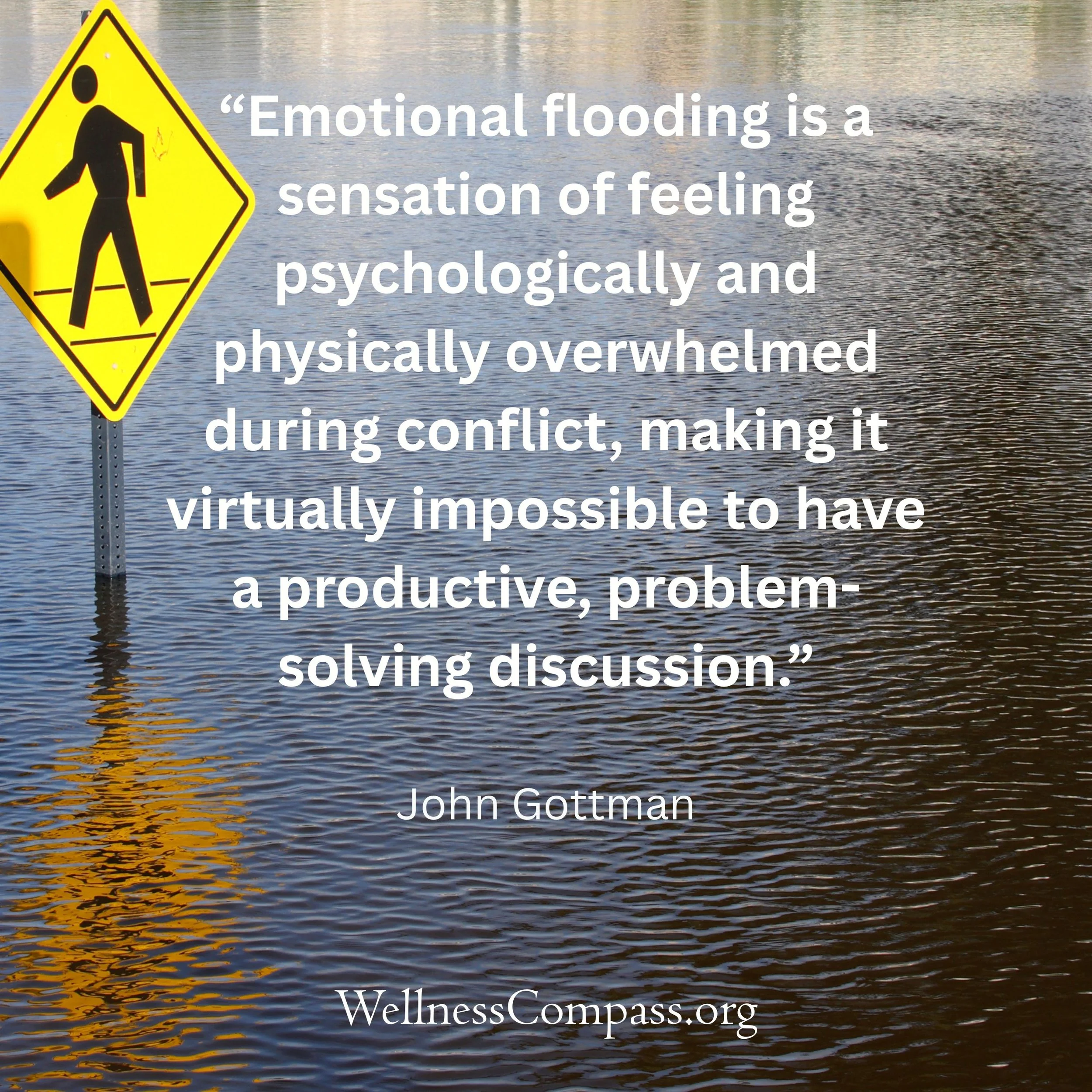
Psychologist and author John Gottman describes emotional flooding as “a sensation of feeling psychologically and physically overwhelmed during conflict, making it virtually impossible to have a productive, problem-solving discussion.”

Here are Four Compass Points to help guide us when this happens.

1. Everyone gets emotionally flooded from time to time, so it's essential to recognize the warning signs when this is happening to us. Pay attention to physical cues like rapid heartbeat, shallow breathing, muscle tension, or feeling hot. Notice emotional signs like racing thoughts, difficulty concentrating, or the urge to react, retaliate, or get even. When you catch these early signals, you can intervene before reaching full emotional overwhelm. Remember that emotional flooding is a natural response to powerful feelings, stress, or trauma—it's not a sign of weakness.

2. Hit the pause button. While we can't always control when our emotions take over, we do have the choice to pause rather than react. When we feel intensity building, we can stop and slow down. We don't have to immediately say what we are thinking or feeling—or send that email, or create that social media post. We can pause by taking a walk, sleeping on it, talking with others, or spending time doing whatever helps us to calm down. 

3. Take responsibility for yourself, rather than blaming others. A classic response of a young child when they have done something they regret is, "but they did it first!" Let's be more mature than that. If someone throws a lit match at us, we are responsible for any gasoline inside of us that leads to an explosion. While someone else may have done something that triggers our emotional flooding, we are responsible for how we handle ourselves at that moment.

4. Saying, "I'm sorry," can be an expression of strength. Impulsive reactions while we are flooded do not come from a place of strength, and yet they happen. Apologizing and making amends when we have said or done things we regret is a sign of strength and a commitment to our ongoing emotional growth.

Making This Personal: 3 Questions

Just as a compass helps us to check our bearings and see if we are on the course we intend, these questions invite us to make these thoughts about emotional flooding personal for each of us. 

1. Have you recently experienced emotional flooding? 

2. If so, how satisfied are you with how you handled it? 

3. Is there anything you learned from your recent experience, or from these four Compass Points, that you want to put into practice going forward? 


Subscribe Now to Weekly Words of Wellness:

Click the button below to signup for the e-mail version of Weekly Words of Wellness. This weekly article can be shared with your community electronically and/or used for group discussion.

You can unsubscribe at any time.
Sign Up

"Navigating Transitions," September 12, 2025


Navigating Transitions

The Wellness Compass Initiative is our partner community wellness initative that serves schools, counseling centers, nonprofits, universities, and other community wellness organizations. Each week Holly Hughes Stoner and Scott Stoner, who are both licensed marriage and family therapists, co- write a column for Wellness Compass and we are pleased to share it here on our Living Compass site. There is also a Wellness Compass podcast at www.wellnesscompass.org/podcast.

Welcome back to season five of the Wellness Compass Column and Podcast. We are glad to be back with you. 

Fall is a time of transitions, and we have one of our own to share with you regarding the structure of this column. Just as a compass has four points, our new format will feature four essential points of wisdom each week on a different wellness or mental health topic. We think you will find this new structure easier to remember and more practical for application in your life. What remains the same is our mission of our overall non-profit Wellness Compass Initiative, now in its eighteenth year: to enhance mental health and resilience in individuals, families, schools, organizations, and communities. As always, we welcome your feedback and suggestions for future topics you would like to see addressed.  

And speaking of transitions, our first column and podcast for this season offers four points for navigating transitions with greater awareness and intention. Whether you or someone else is navigating the start of school transition, or any of a myriad of other changes —such as a job change, coping with loss or a death, adjusting to a new health reality, or a change in a relationship —we hope you find these four points helpful.  

Four Points for Navigating a Transition

1. Normalize and accept the feelings of vulnerability and uncertainty that come with transitions--our own and others. The bigger the change, the deeper the feelings, and the longer the adjustment will take. Don't rush the process of adapting to the change or loss.

2. Relationships can be quite tender during transitions. Resist acting out or projecting your feelings onto others when you are in the midst of change. 

3. Small daily practices, such as morning routines, regular exercise, mindfulness/meditation, and consistent sleep schedules, can provide stability and comfort when life feels uncertain or in flux.

4. Seeking support from friends, family, and professionals during transitions is an expression of wisdom and strength, helping you process emotions and gain perspective.

Making it personal:

Do any of these points speak to you regarding a transition you are navigating? If so, how might you put that into practice?

Do you know someone who is in the midst of a transition that could use your support?


Subscribe Now to Weekly Words of Wellness:

Click the button below to signup for the e-mail version of Weekly Words of Wellness. This weekly article can be shared with your community electronically and/or used for group discussion.

You can unsubscribe at any time.

Sign Up