Savoring the Present Moment


Savoring the Present Moment

As a nonprofit wellness initiative, we are honored to work with organizations worldwide. One of our favorites, though, is right in our hometown—the University of Wisconsin, a school we both happen to have graduated from.

We were on the university campus this week for several meetings. We had the good fortune to interact with many recent graduates, as this past week was the university's commencement ceremony. These graduates had the distinction of having persevered through all the challenges presented by the COVID pandemic and being part of the largest University of Wisconsin graduating class ever.

Many people at the gatherings were talking to these young people, and we noticed something interesting about the interactions we were all having with the graduates we were greeting. Immediately after congratulating them, we all seemed to ask them some version of the question, "So what's next for you?" A few were excited to share their plans, while others became almost apologetic about not being exactly sure what their plans were. We could see that our question had taken a bit of the wind out of their sails. On reflection later that night, we felt embarrassed that we had made the mistake of not simply honoring and celebrating the incredible accomplishment these students had just completed by quickly turning the conversation to "What's next?" 

So the following day, when we were back on campus, we intentionally focussed on congratulating the graduates and then following up with questions about their experiences and achievements. So what did you major in? What was the best part of college for you? What will you miss most? How did COVID impact your experience? These conversations, we found, were much more animated and enjoyable—for us and the students. Some of them, on their own, chose to share their plans, but many simply enjoyed basking in the joy of the present moment. The lesson we learned again this week was how important it is to remember to savor and celebrate the present moment and not always rush so quickly to what's next. 

A story attributed to the renowned cellist Pablo Casals relates to this. It is a story of a time when he asked a young child who had the honor of playing the cello for him, "Do you want to play the cello when you grow up?" A little deflated by the question, the child simply responded, "I'm playing the cello right now." Cassel, though slightly embarrassed at the time, told the story many times later as a reminder to himself and the rest of us of the importance of relishing the moment for what it is in the now and not always being tempted to focus on what might be coming next.  

Over the last decade, there has been a renewed interest in meditative practices like mindfulness, breath meditation, and centering prayer. One thing they all have in common is slowing down one's breath, letting go of distractions, and resting fully in the present moment. In our fast-paced society, where we often seem to be in a hurry to get to the next thing honoring the present moment can be a welcome respite.  

If you have the opportunity to congratulate a gratulate or their parent or other family members this spring, try learning from our little experiment. See if you can focus only on the joy of what they have just accomplished rather than quickly asking what might be next. You will be giving them a gift, and perhaps, yourself as well. 

Making it personal:

1. Have you accomplished something recently that you would like to stop and savor the feeling of accomplishment?

2. Has someone you know graduated or accomplished something else recently? 

3. If so, how might you be in the moment with them as they celebrate this accomplishment?****************************************************************************************************************

To explore your own well-being in the eight areas of wellness, you may be interested in downloading our newest FREE resource, The Adult Wellness Compass Notebook. This workbook is perfect for either individual or group use, and is a tool for self-reflection, learning, and goal setting. Click HERE to download and enjoy.

Each week Holly and Scott Stoner record the Wellness Compass Podcast. Each episode is about 15 minutes and offers a deeper dive into what appears here in the written column. You can listen to the Wellness Compass podcast in your favorite podcast app—just search for “The Wellness Compass,” and you can listen by clicking HERE and scrolling down to this week’s episode.

And speaking of podcasts, Scott has launched a new podcast this week that is just him speaking about a topic that he is passionate about—the integration of spirituality and wellness. You can listen to the newly launched Living Compass podcast by clicking on the word “Podcast” in the bar at the top of this Living Compass webpage or find it in your favorite podcast app (Apple, Google, Spotify, etc.)


Subscribe Now to Weekly Words of Wellness:

Click the button below to signup for the e-mail version of Weekly Words of Wellness. This weekly article can be shared with your community electronically and/or used for group discussion.

You can unsubscribe at any time.
Honoring All the Emotions of Mother’s Day


Honoring All the Emotions of Mother’s Day

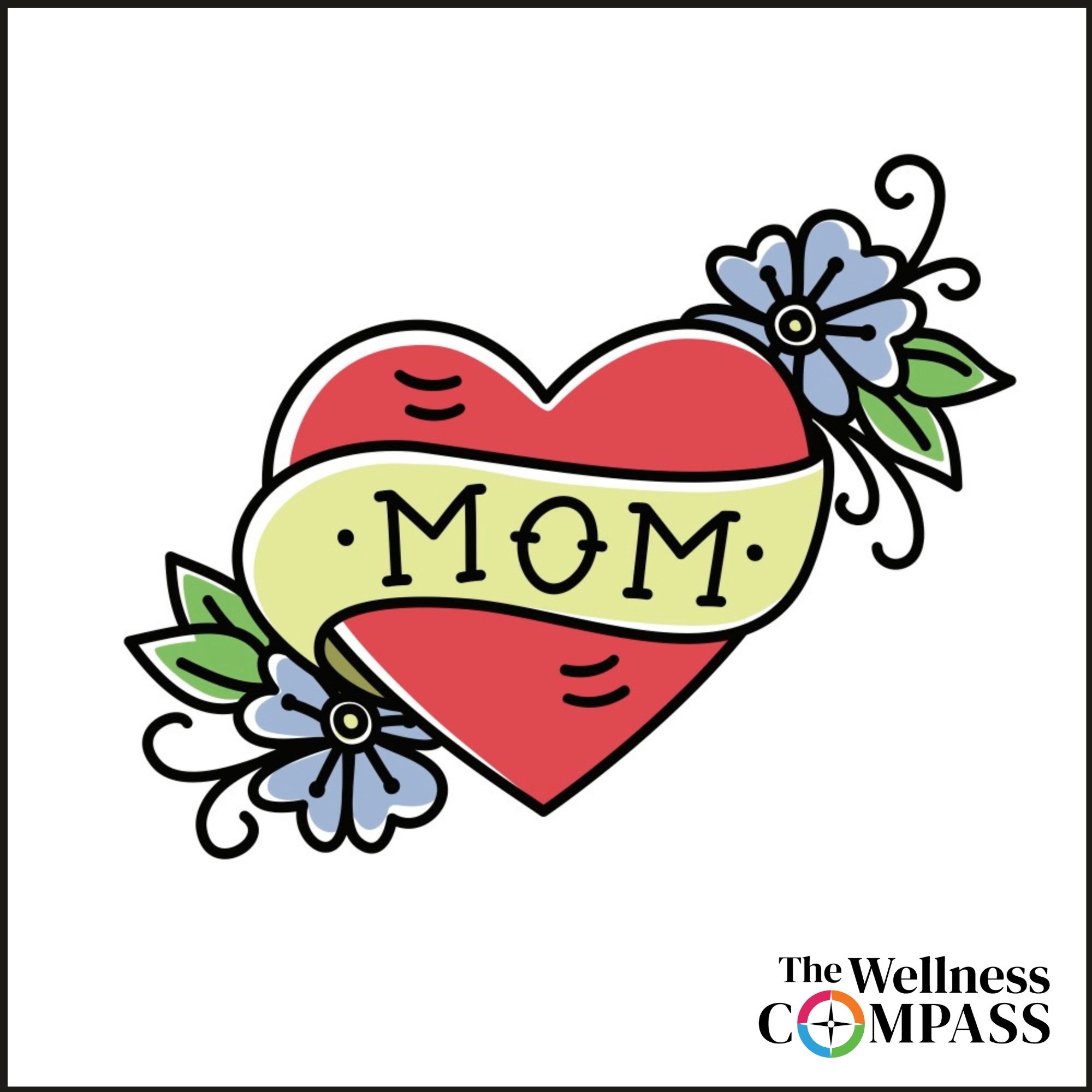
A few months ago, while standing in line at a coffee shop, I noticed a beautiful tattoo on a man's arm right in front of me. It was a heart with the word "Mom" in it. I commented on the tattoo and said, "Your Mom must be very special to you."

My comment evoked some beautiful stories from the man I had just met. Here's my recollection of some of what he told me. “It’s complicated. My mom was very special. She died two years ago, and I got this tattoo to help me remember her. We had a complicated relationship. She struggled with addiction when I was growing up, so she was not well. I also struggled with addiction but got clean ten years ago. She got into recovery near the end of her life, too, and we had some beautiful years together—making up for lost time. Our relationship was complicated but loving, and in the end, it was so good, and I miss her so much." I thanked him for sharing his story and told him how touched I was by it.

Relationships are indeed complicated and filled with complex emotions. We often teach that one of the hallmarks of emotional wellness is being comfortable with feeling and expressing the full range of our emotions.  

Imagine that the full range of emotions exists on a scale from zero to ten. Now think of 0-5 as the "unpleasant" emotions, like sadness, anxiety, worry, anger, and fear. Next, think of 6–10 as the "pleasant" emotions, such as joy, love, happiness, excitement, and peace.

Most of us are relatively comfortable feeling and expressing the 6-10 emotions, yet it seems many of us try to avoid feeling and expressing our 0-5 emotions This makes sense as everyone likes having, talking about, and listening to ones with the higher number, and the reverse is true with the lower numbered emotions as they are more challenging to feel and to listen to others we care about express them.

 Here, however, is an important insight regarding this range of emotions: if we block out the 0-5 emotions, we will soon notice that we feel far less of the 6-10 emotions. Author Jim Rohn makes this point, as well: "The walls we build around us to keep sadness out, also keeps out the joy."

Emotions are not good or bad; they simply are. They are like a thermometer, giving us a read on the world around us. Watch a young child; within thirty minutes, you will notice that they are comfortable experiencing the full range of "0-10" emotions. They don't try to build walls around their feelings to protect themselves and don't get stuck in any one emotion. If we are willing to genuinely listen to and accept all of our feelings without judgment as they do, we, too, can avoid getting stuck in any one emotion. 

We share all of this today because this weekend is Mother's Day and based on our decades of experience as therapists, we know that Mother's Day naturally evokes the whole range of "0-10" emotions. If you are filled with love and joy this weekend, then celebrate that, and when possible, express it. If, on the other hand, you are feeling grief or sadness, honor those emotions, too. Share them with others you trust to be there for you as you grieve. 

Sometimes holidays create an expectation or pressure to feel a certain way, which is unrealistic and can be detrimental to our mental health. Befriend your emotions and accept them as a message from yourself. Most likely, they could benefit from your care and attention.

Making It Personal: 

What emotions are you feeling as Mother's Day approaches? 

Are there feelings of love and gratitude that you want to be sure to express?

Are there other feelings that maybe you are having this year that you also want to express? ****************************************************************************************************************

To explore your own well-being in the eight areas of wellness, you may be interested in downloading our newest FREE resource, The Adult Wellness Compass Notebook. This workbook is perfect for either individual or group use, and is a tool for self-reflection, learning, and goal setting. Click HERE to download and enjoy.

Each week Holly and Scott Stoner record the Wellness Compass Podcast. Each episode is about 15 minutes and offers a deeper dive into what appears here in the written column. You can listen to the Wellness Compass podcast in your favorite podcast app—just search for “The Wellness Compass,” and you can listen by clicking HERE and scrolling down to this week’s episode.

And speaking of podcasts, Scott has launched a new podcast this week that is just him speaking about a topic that he is passionate about—the integration of spirituality and wellness. You can listen to the newly launched Living Compass podcast by clicking on the word “Podcast” in the bar at the top of this Living Compass webpage or find it in your favorite podcast app (Apple, Google, Spotify, etc.)


Subscribe Now to Weekly Words of Wellness:

Click the button below to signup for the e-mail version of Weekly Words of Wellness. This weekly article can be shared with your community electronically and/or used for group discussion.

You can unsubscribe at any time.

Let Your Life Speak: Listening to Our Souls


Let Your Life Speak: Listening to Our Souls

Most nonprofit organizations have mission statements. These statements succinctly state the purpose of the organization in order to inform and guide those who work for or support the organization. 

Here are a few such statements from some organizations you might know:

"The American Red Cross prevents and alleviates human suffering in the face of emergencies by mobilizing the power of volunteers and the generosity of donors."

"The mission of the American Cancer Society is to improve the lives of people with cancer and their families through advocacy, research, and patient support, to ensure everyone has an opportunity to prevent, detect, treat, and survive cancer."

"Feeding America's mission is to advance change in America by ensuring equitable access to nutritious food for all in partnership with food banks, policymakers, supporters, and the communities we serve."

Our Wellness Compass Initiative is a nonprofit program, so we also have a mission statement. "The Wellness Compass Initiative is a nonprofit with a mission to enhance mental health and resilience in individuals, families, schools, organizations, and communities."

Today's column is our fourth in a series on "Let Your Life Speak." This week we focus on spirituality and listening to our souls as they relate to our core beliefs and values. It is our response to the question, "What's your why?" A person’s why may be expressed through our spirituality in religious beliefs or practices, or it may be expressed in a manner that is separate from a formal religious tradition.  

An individual's spirituality is like a nonprofit organization's mission statement. If you were to write a mission statement for your life, it would be an expression of your spiritual beliefs. To use the metaphor of a compass, spirituality is our true north.  

Just as mission statements help organizations know what to say yes to and what to say no to, our core values and beliefs do the same for us as individuals. When we say yes to things that do not align with our spirituality, we will eventually find a sense of unease as our souls speak to us, letting us know we are getting off course.

Our souls contain deep wisdom. We are wise to listen to them, especially when they let us know that we are veering away from our sense of true north.  

Making It Personal: 

If you were to write a personal mission statement, what would it be?

Might you be willing to try doing so?

How do you recognize when you are getting out of alignment with your spiritual values and beliefs, and what helps you to get back on course?****************************************************************************************************************

To explore your own well-being in the eight areas of wellness, you may be interested in downloading our newest FREE resource, The Adult Wellness Compass Notebook. This workbook is perfect for either individual or group use, and is a tool for self-reflection, learning, and goal setting. Click HERE to download and enjoy.

Each week Holly and Scott Stoner record the Wellness Compass Podcast. Each episode is about 15 minutes and offers a deeper dive into what appears here in the written column. You can listen to the Wellness Compass podcast in your favorite podcast app—just search for “The Wellness Compass,” and you can listen by clicking HERE and scrolling down to this week’s episode.

And speaking of podcasts, Scott has launched a new podcast this week that is just him speaking about a topic that he is passionate about—the integration of spirituality and wellness. You can listen to the newly launched Living Compass podcast by clicking on the word “Podcast” in the bar at the top of this Living Compass webpage or find it in your favorite podcast app (Apple, Google, Spotify, etc.)


Subscribe Now to Weekly Words of Wellness:

Click the button below to signup for the e-mail version of Weekly Words of Wellness. This weekly article can be shared with your community electronically and/or used for group discussion.

You can unsubscribe at any time.

Let Your Life Speak: Nurturing Our Relationships


Let Your Life Speak: Nurturing Our Relationships

As marriage and family therapists, people often reach out to us because there is a relationship in their life that they want to improve. It might be a relationship with a friend, neighbor, colleague, partner, spouse, sibling, or another family member. 

These requests remind us of two things. First, relationships are critical to our well-being, as few things affect the quality of our lives more than the quality of our relationships. The second thing these requests remind us of is that relationships are complicated, requiring an ongoing commitment to maintain and strengthen them. As the quote above says, “Human relationships are not rocket science--they are far, far more complicated.”

So while relationships are complicated, here are several principles that we find to help keep them on track. 

*Whatever we pay attention to is what will grow. If we pay attention to our relationships and water them regularly with positive attention and kindness, they will grow. As we like to say, “The grass is greener where you water it.”

*We often have more agency to change and improve a relationship than we realize. While this is not always the case, we often can do things, including having difficult conversations, rather than avoiding them, to help shift a relationship stuck in a painful or unhealthy pattern. We may need to ask for professional help to do this, but change can happen with commitment and intention.

*Old patterns take time to change. Each of us has internalized relationship patterns from our childhood. Some of those patterns serve us well, and others may not. While changing these patterns is not easy, it is possible. We need to be patient and loving with ourselves (and others) as we, with time and effort, try to make these changes.  

*Love is a decision. While love is undoubtedly a feeling, too, feelings ebb and flow. Long-term relationships of every kind (between partners, friends, siblings, colleagues, etc.) require a commitment of the will. Deciding to continue to invest in the relationship even when the feelings are uncomfortable is an essential aspect of nurturing our relationships.

*The best time to have a difficult conversation about a difficulty in a relationship is when that difficulty arises. The second best time is today. Avoiding hard conversations almost always makes them more challenging to have later on. As we wrote last week, “The more you hide your feelings, the more they grow.”

Relationships are complicated. Some say they are more complex than rocket science. They are also essential to our well-being. Hopefully, the principles we have shared will make nurturing your relationships a little less complicated. 

Making It Personal:

1. Did one of the principles we shared speak especially to you? 

2. If so, is there a specific relationship you might apply it to right now? ****************************************************************************************************************

To explore your own well-being in the eight areas of wellness, you may be interested in downloading our newest FREE resource, The Adult Wellness Compass Notebook. This workbook is perfect for either individual or group use, and is a tool for self-reflection, learning, and goal setting. Click HERE to download and enjoy.

Each week Holly and Scott Stoner record the Wellness Compass Podcast. Each episode is about 15 minutes and offers a deeper dive into what appears here in the written column. You can listen to the Wellness Compass podcast in your favorite podcast app—just search for “The Wellness Compass,” and you can listen by clicking HERE and scrolling down to this week’s episode.

And speaking of podcasts, Scott has launched a new podcast this week that is just him speaking about a topic that he is passionate about—the integration of spirituality and wellness. You can listen to the newly launched Living Compass podcast by clicking on the word “Podcast” in the bar at the top of this Living Compass webpage or find it in your favorite podcast app (Apple, Google, Spotify, etc.)


Subscribe Now to Weekly Words of Wellness:

Click the button below to signup for the e-mail version of Weekly Words of Wellness. This weekly article can be shared with your community electronically and/or used for group discussion.

You can unsubscribe at any time.

Let Your Life Speak: Listening to Our Emotions


Let Your Life Speak: Listening to Our Emotions

This is the second column in our series entitled "Let Your Life Speak." Our first column focused on listening to our bodies, and this week we are focusing on listening to our emotions.  

The quote we share above succinctly captures what we want to say about this topic.

The first part of the quote is, "The more you hide your feelings, the more they show." When I (Scott) was younger and not as comfortable expressing my emotions, I can remember saying, "I am NOT MAD," or "I am NOT SAD," with such force that it was pretty evident to anyone listening that I was, of course, completely feeling those exact emotions. I was not yet, however, capable or comfortable in expressing them in a helpful way. The more I tried to hide or deny those feelings, the more they showed, but not in healthy or beneficial ways.

The second part of the saying is, "The more you deny your feelings, the more they grow."

Imagine standing in a swimming pool, and someone hands you a beach ball. Now imagine you try to submerge the ball and try to sit on it while it is entirely underwater. You might be able to do it for a moment, but surely it will be evident to anyone looking that you are trying to hold something down that naturally wants to come to the surface. That's what trying to repress our emotions looks and feels like. We might be able to do it in the short run, but it will be exhausting, and the pressure to let the feelings come to the surface will only grow. Eventually, everyone around you will soon recognize that you are hiding something, but will be unable to help as they won't know quite what is going on "under the surface."  

The expression, "I had a good cry," speaks to the wisdom of being able to feel and express the full range of emotions. A good cry releases the pressure of our feelings, which is why we feel relief. If you think of the "motions" part of the word "emotions," it is a helpful reminder that our emotions want and need to be in motion. They need to be expressed and not bottled up. 

Of course, not all expressions of emotions are healthy, and so learning to do so is a skill that takes practice, as any parent knows who is teaching their children the difference between healthy and unhealthy expressions of feelings. The key here is that emotions are not healthy or unhealthy—they simply are a natural part of who we all are. How we express our feelings is what can be healthy or not. 

We have more to say on this topic in the podcast accompanying this week's column, so if you have fifteen minutes, we hope you will listen.  Click here to listen.

As we say at the end of every podcast episode, we are so grateful to be walking this journey toward wellness and wholeness with you. Our feelings of gratitude are definitely feelings we want to share with others!

Making It Personal: 

1. How comfortable are you with experiencing and expressing the full range of your emotions? 

2. Can you think of ways in which the words of the quote we share above have been or are currently true for you? 

****************************************************************************************************************

To explore your own well-being in the eight areas of wellness, you may be interested in downloading our newest FREE resource, The Adult Wellness Compass Notebook. This workbook is perfect for either individual or group use, and is a tool for self-reflection, learning, and goal setting. Click HERE to download and enjoy.

Each week Holly and Scott Stoner record the Wellness Compass Podcast. Each episode is about 15 minutes and offers a deeper dive into what appears here in the written column. You can listen to the Wellness Compass podcast in your favorite podcast app—just search for “The Wellness Compass,” and you can listen by clicking HERE and scrolling down to this week’s episode.

And speaking of podcasts, Scott has launched a new podcast this week that is just him speaking about a topic that he is passionate about—the integration of spirituality and wellness. You can listen to the newly launched Living Compass podcast by clicking on the word “Podcast” in the bar at the top of this Living Compass webpage or find it in your favorite podcast app (Apple, Google, Spotify, etc.)


Subscribe Now to Weekly Words of Wellness:

Click the button below to signup for the e-mail version of Weekly Words of Wellness. This weekly article can be shared with your community electronically and/or used for group discussion.

You can unsubscribe at any time.