Flattening the J Curve

J Curve Graphic.jpg


Flattening the J Curve

“We may not ever understand why we suffer or be able to control the forces that cause our suffering, but we can have a lot to say about what the suffering does to us, and what sort of people we become because of it.”

—Rabbi Harold S. Kushner, When Bad Things Happen to Good People

     There is wisdom in the J curve, for it helps us to understand what we experience during times of significant change and disruption.

   Note from the diagram that the vertical axis of the J curve is "Stability," while the horizontal access is "Resilience/Growth." When change occurs in our lives, the graphic shows that stability begins to decline. When change is significant—a move, the loss of a loved one, the loss of a job, or as now, experiencing a pandemic, the decline in stability can be steep.  

   One natural reaction to a sudden experience of instability is, "I want to go back. If only I could back to the way things were, everything would be okay." A second common reaction is "I want this uncertainty to be over NOW—I want to be on the other side of the "J" curve as quickly as possible," even if it means trying to minimize or deny the significance of what is currently happening.

   While these two responses are natural, we soon realize that we can't go back, and we also cannot force or rush the resolution of what we are going through. There are, fortunately, choices we can make that will significantly affect how deep our J curve experience will be. 

   We are quite familiar now with the term, "Flatten the curve," and so here are four specific things we can do to flatten any J curve. 

  Befriend Solitude: Turn off all your screens and try to spend at least ten minutes each day being still. You might pray, or meditate, or practice mindfulness. Or you might simply sit still and focus on your breathing. If anxious or distracting thoughts arise, just note them and let them pass, as if you were sitting on a riverbank watching a leaf float by until it eventually floats out of sight.  The mindfulness app Headspace has free meditations available now that are easy to access.  

  Connect With Others: We know that distancing ourselves from others flattens the pandemic curve. Making time each day to connect with others helps to flatten the J curve. Fortunately, there are many options for connecting with others. Use the ones that work for you. Connect with at least one person or more for at least fifteen minutes each day. If you are living with others at this time, make intentional time each day to meaningfully connect with each person in your household. 

  Nurture Your Spirituality: Nurturing your spirituality is crucial for supporting your journey through change and disruption. If you are a praying person, pray. If you are a religious person, deepen your practice of your faith. When possible, spend time in nature. Read poetry. Listen to music. Do whatever feeds your spirit.

  Offer Kindness to Others: Offer one act of kindness to others each day. Call someone who is alone. Call someone who is grieving. Donate to a group that is helping others. Give a larger tip if you do takeout from a restaurant. My daily runs benefit from the kindness of children who use chalk to regularly write words of encouragement for those passing by on the sidewalks in front of their homes

  Every one of us is experiencing some degree of change and instability, some degree of a J curve right now. None of us planned for or chose this particular pandemic J curve. We can, however, make choices that will help to flatten the curve by practicing the things I have outlined here.


Subscribe Now to Weekly Words of Wellness:

Click the button below to signup for the e-mail version of Weekly Words of Wellness. This weekly article can be shared with your community electronically and/or used for group discussion.

You can unsubscribe at any time.
Keep the Problem the Problem

 
Keep the Problem the Problem
 

Keep the Problem the Problem

 I have shared the story I am about to share in this column once or twice previously because living through it taught me a  valuable lesson. I'm also sharing it now believe its lesson is especially applicable to the situation many of us find ourselves in today, sheltering in place for what has been more than a month now.

    My wife and I love to spend time in the wilderness, as we love the quiet and spiritual nourishment we receive by being in nature. So several years ago, we were canoeing in Quetico Provincial Park in Ontario, Canada, a very remote park that is only accessible by canoe. I remember well an experience we had one stormy day. We had awoken early and had to decide whether it was safe to spend the day on the water, as a storm was predicted later in the day. I thought we should stay put where we were sheltered on shore. She thought it made sense to take off and try to get to the next lake a mile or so away before the storm arrived.  After a brief discussion, we decided to take off, hoping for the best. 

 We loaded up the canoe with all our packs and took off across the vast lake we had been camping on. A half-hour later, we were in the middle of the lake, and a strong thunderstorm suddenly arose. Fifteen minutes from the closest shore, we glanced behind us and noticed that the storm had come up quicker than we expected. In the next few minutes, we became uncomfortably aware that the sky was becoming black, the wind was whipping around us, and the temperature was dropping. Soon there was lightning in the distance, and we both knew the last place we wanted to be at that moment was sitting in a canoe in the middle of that large body of water. We were scared.

   So what did we do? We did what any two people would do in such a situation.  We began to have a fight right there in the middle of the lake.  The argument started when I started to raise my voice over the wind, yelling, "I told you there was a chance of a storm and that we shouldn't  come out here today!" (Note to self: saying "I told you so" never helps resolve anything). Soon the shouting went back and forth, with her asking and directing, "Why aren't you paddling harder? Don't paddle on the left, paddle on the right!" And then we began to disagree about which point on the horizon was our desired destination. After a few minutes of futile arguing, we looked at each other and realized how silly we were being. We took a deep breath, double-checked the map, and resumed paddling. 

 When we finally reached shore and could later talk about what happened, we realized that out on the water, we had not really been mad at each other, but instead, the approaching storm had scared us both so much that we had begun to turn against each other. The storm was the "problem," and yet in the midst of our anxiety, we had temporarily made each other the "problem."

    Whenever people find themselves in the midst of a "storm," they are vulnerable to turning against one another, rather than turning toward one another for support and cooperation. The world is currently in the midst of a "storm" like we have never experienced. If you are sheltering in place with others, you may find that you are getting on each other's nerves, becoming more irritable, and even fighting. You might find yourself lashing out at state and national leaders. You might hear yourself sounding like my wife, and I did that day on the lake, yelling such things as, "I told you so. You are not paddling hard enough. Why do I always have to do all the work around here? Nobody appreciates how hard I'm working." 

    All people are vulnerable to turning against one another when experiencing fear in the midst of uncertainty. Today this includes couples, families, friends, businesses, work teams, politicians, and organizations. Every one of us has experienced some degree of loss and disruption, some much more than others, and some have suffered losses so severe they wonder how they will ever recover.

   Whenever I work with a family or organization that is in conflict, I almost always, at some point, share the mantra, “Keep the problem the problem, and don’t make a person the problem.”  Because when we begin to think that the other person the problem, not only do we injure the relationship with that person, but we also stop focussing on the real problem. When my wife and I were so busy yelling at each other, neither one was paddling; neither one of us was addressing the real problem ahead of us, the storm that was surrounding us, and our need to get off the lake.

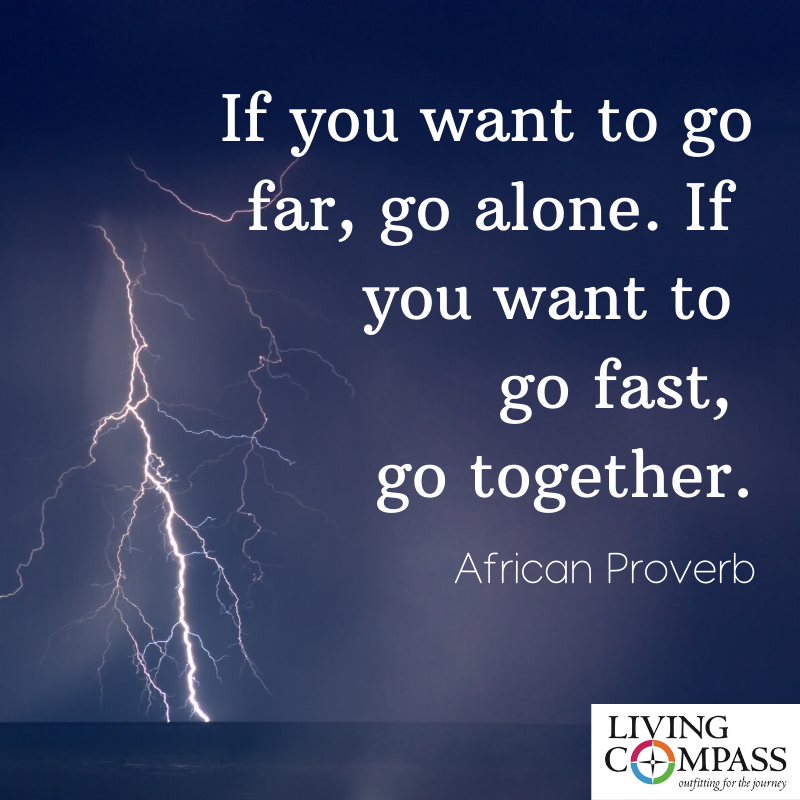
   We are all now in the midst of a big storm, and we are going to be paddling together through it for what looks to be a long time. I, for one, will try to remember to keep my focus on the problem and not make others the problem. Even more, I will remember that others are an essential part of the solution, as the African proverb reminds us: "If you want to go fast, go alone. If you want to go far, go together."

   But just as soon as I commit to not blaming others, I realize how hard it can be to put this into practice. Because seriously, "Why am I the only one around here who EVER unloads the dishwasher?!”


Subscribe Now to Weekly Words of Wellness:

Click the button below to signup for the e-mail version of Weekly Words of Wellness. This weekly article can be shared with your community electronically and/or used for group discussion.

You can unsubscribe at any time.

The Ground Begins to Soften, Easter 2020

 
The Ground Begins To Soften Easter 2020
 

The Ground Begins to Soften, Easter 2020

 ( Several years ago, I wrote a column similar to this for Easter. What I wrote seems particularly relevant for the unprecedented circumstances we now find ourselves in, and so I have updated it for this year.)

   For those of us who celebrate Easter in the northern hemisphere, we are blessed to be surrounded by abundant symbols of resurrection and rebirth, including the new buds on the trees, the return of birds that have been south for the winter, the lengthening of the days, and the overall warming temperatures. For me, though, there is one sign in nature that is the most meaningful indicator of new life this time of year, one that is probably easy to overlook…the ground begins to soften.

   First, the snow melts, and then gradually, the ground that has been covered and frozen all winter begins to thaw and soften. One thing I love about the ground starting to soften is that I am able to move my runs off the concrete sidewalks and onto the soft earth, which provides a welcome cushion for my aging joints. The softening ground is moist this time of year, and I love the squishing sound that my shoes make with every step I take. The softer ground also means those with green thumbs are getting back to digging in the earth of their gardens. The softer earth gives rise to so many beautiful stirrings of new life.

  This year, the celebration of Easter (as well as Passover) occurs in the midst of a pandemic. Communal celebrations will not happen, and friends and extended families will make the courageous choice not to gather. It is a time of significant vulnerability and loss for all of us. And as with all experiences of vulnerability and loss, we have two choices. We can choose to harden our hearts, like the hardened earth of winter, as a way to try and protect ourselves. Or we can choose to soften our hearts amid the vulnerability and fragility we are experiencing, becoming like the soft earth of spring. Choosing the latter makes it possible for the seeds of Easter hope to take root more easily and deeply.

  As we celebrate Easter this weekend, we are not just celebrating something that happened almost 2000 years ago; we are also celebrating the truth that God continues to make things new, that God continues to bring life out of loss, and that new life will follow even this pandemic. The image of the ground beginning to soften is a vivid metaphor reminding us of what it can feel like when God is beginning to do a new thing in our lives.

  I know this feeling in my own life, and I see it in my work as a minister and a therapist as well. People usually come to see me because life has become hard for them, literally. They come in with hearts, minds, souls, and even bodies that have become hardened and rigid. They come alone, or they come with their loved one, or they bring their whole family because everyone has become hardened to each other. This hardness is usually the result of some frozen sadness or hurt, or unresolved conflict or grief, and the hardness has built up over a long time.

   Why have they come? Because deep down, they don't want to be hard-hearted, hard-minded, or hard-spirited, toward themselves or toward the people they love most. Deep down, a small, still voice longs for something different. And because they are willing to listen to this longing, slowly, imperceptibly at first, a miracle begins to happen. The ground begins to soften. 

The softening heart/mind/soul, just like the softening earth, soon gives rise to all kinds of miraculous new life. People forgive each other, and they forgive themselves. People who haven't done so for a long time touch and hug again. There is laughter where once there was criticism and hurt. There is joy where there once was shame and guilt. Grief gradually loosens its grip. There is freedom where there once was bondage. There is life where there once was death. Resurrection happens. 

There is always a risk in the choice to soften our hearts and allow the seeds of Easter hope to take root, but it is always a risk worth taking.

  To all who celebrate this holiday, we at Living Compass wish you a Happy Easter. May all of our hearts and souls be softened today by the presence of the One who continues to call forth new life in the midst of loss.


Subscribe Now to Weekly Words of Wellness:

Click the button below to signup for the e-mail version of Weekly Words of Wellness. This weekly article can be shared with your community electronically and/or used for group discussion.

You can unsubscribe at any time.

Everyone Is Fighting a Hard Battle

 
Everyone is fighting a hard battle
 

Everyone Is Fighting a Hard Battle

  I am finding that the ongoing experience of the pandemic is similar to having a large application open on my computer’s desktop. It is always there, running in the background. And even if I’m not currently thinking about the pandemic, it is still there, zapping energy from all the other applications I am trying to operate. 

 This metaphor helps me to understand why so many of us are all feeling a bit “off” right now. We may turn the news off for a while and try not to think about what is happening, but there is no way to “force quit” what’s going on in the world. 

 I share this in hopes that it can give us all permission to be a little more patient and gentle with ourselves and everyone whom we encounter. The mental and spiritual health challenges are mounting for all of us. How could it be otherwise?

 In early February, I wrote a column about mindful self-compassion (you can find it at https://www.livingcompass.org/wwow/mindful-self-compassion.) I find it to be a helpful practice for my own emotional and spiritual well-being right now. If you are looking for another habit to add to your now regular habit of handwashing, I highly recommend it.  

 Finally, I am also finding that it really helps to give myself permission not to be my ordinarily productive self. There is nothing ordinary about this time, and we are wise to not hold ourselves to standards that simply don’t apply right now. Until the pandemic subsides, all of the other applications in our lives (and in the lives of those we love) will run a little more slowly and a little less efficiently.  

 So remember to be kind, for everyone you meet, including yourself, is fighting a hard battle.


Subscribe Now to Weekly Words of Wellness:

Click the button below to signup for the e-mail version of Weekly Words of Wellness. This weekly article can be shared with your community electronically and/or used for group discussion.

You can unsubscribe at any time.

The Hidden Curriculum

 
The Hidden Curriculum
 

The Hidden Curriculum


  I am married to a former teacher. I have recently been thinking about the idea of the "hidden curriculum," a concept I learned from her quite a few years ago. This concept refers to lessons and values that students learn, sometimes unintended because they are not directly part of the subject being taught in the curriculum. This could include planning ahead, getting along with others, the importance of honesty, and other important lessons related to values and character.

  I thought about the idea of the hidden curriculum in light of how all of us, adults and children, are currently being homeschooled in the midst of the current pandemic. I began to reflect on what unintended lessons I am learning in the midst of my own at home learning experience.

  I'm guessing you are learning a few lessons of your own, and thus I will invite you near the end of this column to share yours on our Living Compass Facebook page.

Here is what I am learning at this moment, in no particular order.  

1. We are all more interdependent and interconnected than I ever realized. I am reminded of a quote I heard a few years ago, "When 'I' is replaced with "We" Illness becomes Wellness. It will require a worldwide collective "we" to get to the other side of this

2. My life is enriched because I am listening to more music while at home, thanks, in large part, to the many artists who are sharing live performances online right now. Music (for me) is the language of the soul. Case in point—check out one of Yo Yo Ma's current online offerings.

3. The word essential has taken on new meaning for me. As in nurses, grocery store employees, skilled-care facility workers, teachers, mental health providers, food producers, childcare workers, pharmacy workers, truck drivers, first responders, doctors, farmers, and all who work in health care.  

4. Heartfelt expressions of love and gratitude can sometimes make me cry. I'm referring to the video that shows hundreds of people who come out on their high-rise balconies in Atlanta to applaud the healthcare workers at a nearby hospital during each evening's shift change.

5. I now realize I have taken the opportunity to give and receive affection for granted. I so very much miss being able to hug my grandchildren and so many other people I love. 

6. A long walk or a good run does wonders for my mood. Even more so when said walk or run is through the woods or in a park.  

7. Ditto for the wonders of a good night's sleep.

8. Ten to twenty minutes of some form of spiritual practice each morning (mindfulness, centering prayer, spiritual reading) helps me to be less anxious throughout the day.

9. Brené Brown often has just the words that I need to hear. This week she wrote, "The pandemic experience is a massive experiment in collective vulnerability. We can be our worst selves when we're afraid, or our very best, bravest selves. In the context of fear and vulnerability, there is often very little in between because when we are uncertain and afraid our default is self-protection. We don't need to be scary when we are scared. Let's choose awkward, brave, and kind. And let's choose each other."  

10. Parents are some of the hardest working and often most under-appreciated people I know. They need our encouragement and support, now more than ever.  

11. Grief expresses itself in a myriad of ways, including anger, fighting, illness, hopelessness, distancing, shutting down, numbing out, and exhaustion. And the amount of grief and loss that so many are experiencing right now is getting very real. Let's give ourselves and others the space needed to feel and express loss.

12. The human spirit is resilient and beautiful in ways that continually inspire me.

13. Healing cannot be rushed, and it always takes longer, sometimes way longer than I wish it would.

  When I look back over my life, I see that the times that I experienced the most profound spiritual growth were often during and after times of loss and upheaval. For this reason, I know this time contains a hidden curriculum that will forever influence the way I live my life. A wise friend of mine (thank you, Julia Gray) shared a quote this week that sums this up, "In a rush to return to normal, may we use this time to consider which parts of normal are worth rushing back to."

  We are all students and teachers in this collective, unfolding journey. I invite you to share what you are learning by posting your wisdom on our Living Compass Facebook page, which you can find HERE

  What's been the hidden curriculum for you during this pandemic, and what have you learned so far?


Subscribe Now to Weekly Words of Wellness:

Click the button below to signup for the e-mail version of Weekly Words of Wellness. This weekly article can be shared with your community electronically and/or used for group discussion.

You can unsubscribe at any time.