Loving Your Neighbor As Yourself

 
Loving Your Neighbor As Yourself
 

 Loving Your Neighbor As Yourself

  All of the world’s major religions have some version of the teaching, “Love your neighbor as yourself.” That teaching is certainly at the core of my own spirituality, and I strive (but often fall short) to live out this ideal every day. I imagine the same is true for many of the readers of this column.

  Some time ago, as I was reflecting on this teaching about loving your neighbor as yourself, it occurred to me that, in fact, this is precisely what most of us do. We actually do love them as we love ourselves. 

  Last week I wrote about self-compassion and how our well-being is enhanced when we can tame our inner critic, and then truly feel love and acceptance toward ourselves. A common reaction I get when I write or talk about self-compassion and self-care is questioning whether what I’m talking about is encouraging someone to become more self-centered. 

  My first response to such a question is merely to state the fact that “You can’t pour from an empty cup.” If there is nothing in our emotional and spiritual cups, we then have nothing to give to others. If we spend much time around people whose cups are chronically empty, we will discover that not only do they not have much to offer, but usually, they will zap our energy as well, and before long, we will be empty too. Self-care keeps our cups full so that we then have something to share with others.

 The second response I have to the question about whether self-care is selfish is to make the point that there is a strong correlation between the way we care for ourselves and the way we care for others. This is what I mean when I say we tend to love and relate to others in a manner similar to the way we love and relate to ourselves. 

  If you are a perfectionist, for example, and tend to be very hard on yourself, you likely relate to others in your life the same way. On the other hand, if you practice self-compassion toward yourself, especially when you make mistakes or fall short of an ideal you have for yourself, it is likely that you offer compassion to others when they inevitably make mistakes.

  Do you see a connection with how patient you are with yourself and how patient you are with others? Do you see a link between how comfortable you are with your own vulnerability and how you respond to others when they are vulnerable?  

 Today is Valentine’s Day, and I invite us to expand the focus of this day to honor and reflect on how we love ourselves and all the “neighbors” in our lives—friends, family members, spouses, partners, colleagues, even strangers. As you celebrate this day, take a moment to reflect on whether you see a connection between how you love yourself, and how you love your neighbor. 

   Happy Valentine’s Day everyone!


Subscribe Now to Weekly Words of Wellness:

Click the button below to signup for the e-mail version of Weekly Words of Wellness. This weekly article can be shared with your community electronically and/or used for group discussion.

You can unsubscribe at any time.
Mindul Self-Compassion

 
Mindful Self-Compassion
 

Mindful Self-Compassion

   My wife and have spent the last two days working at the Adolescent Health Conference in Madison, Wisconsin. Two hundred professionals—school counselors, teachers, psychotherapists, physicians, and case managers—attend this annual conference put on by the University of Wisconsin-Oshkosh. Our Samaritan Family Wellness Foundation is honored to support this conference as a sponsor, as well as being presenters.

   The secular division of our foundation creates teen, parent, and adult resources for the professionals who are on the front lines working with the mental health challenges face by young people and their families today. The need is more significant than ever because the mental health challenges in our young people are great.  

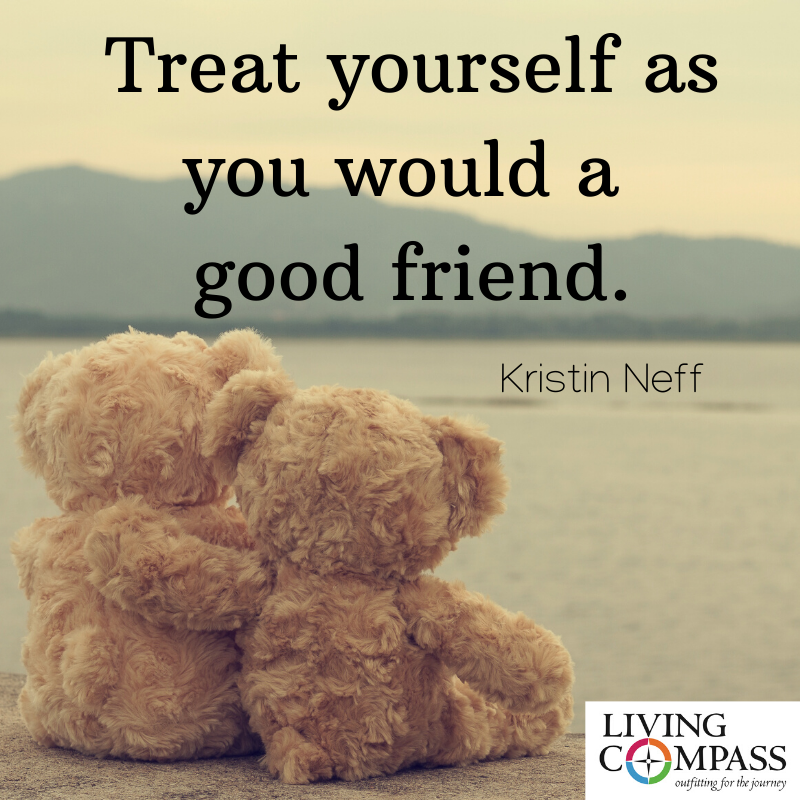
   One of the benefits of being at a health and wellness conference is the opportunity to learn from the experience and expertise of other presenters. A workshop on the benefits of helping teens to develop mindful self-compassion skills was the presentation that was most helpful to me personally and professionally. It was there that I heard the quote from Kristen Neff, one of leading experts in the self-compassion movement, found in the box at the top of this column, “Treat yourself as you would a good friend.”

   The research presented at our conference confirms that it’s a hard time to be an adolescent. Social media is only part of the problem, but one that can significantly magnify feelings of self-criticism for an already vulnerable or suffering teen. Teaching young people mindful self-compassion helps them to quiet their inner critics and to learn to love, accept, and appreciate themselves for who they are. It also helps them to normalize the natural ups and downs they experience as adolescents.

   It turns out that we adults, even we professionals it was pointed out, can also benefit from practicing self-compassion. Those who are quite compassionate with others can, maybe surprisingly, be unduly hard on themselves. I, for one, have always wrestled with a loud inner critical voice, and so I was much helped by learning more about self-compassion this week. There seemed to be a consensus amongst all the workshop attendees that there was a need to practice this, as much for ourselves as there was for teaching it to the youth with whom we work.  

  In closing, if you would like to find out more about self-compassion, I highly recommend watching a short six-minute video from expert Kristin Neff. You may even want to try putting what she teaches into practice, as a gift to yourself.  

 You can find the video at: https://www.youtube.com/watch?v=11U0h0DPu7k


Subscribe Now to Weekly Words of Wellness:

Click the button below to signup for the e-mail version of Weekly Words of Wellness. This weekly article can be shared with your community electronically and/or used for group discussion.

You can unsubscribe at any time.

Your Spirit Is Contagious

 
Your Spirit Is Contagious
 

Your Spirit Is Contagious

  Recent concerns about the coronavirus remind us of just how connected we all are to each other, and how quickly a virus can spread. Here in the North, it is winter, which means it is also cold and flu season. This means that on any given day, we are either the one with a cold or we are likely encountering someone that has a cold. So the question that is never far from our minds is, "Am I or is he/she—contagious?"

When I have a cold, I certainly never intentionally want to spread it to others. At the same time, though, I sometimes am so excited to see someone that I haven't seen for a while that I hug them or shake their hand without thinking. I have also been known to show up at work when I am sick, only to be sent home by colleagues who rightfully request that I not come back until I am no longer contagious.

We, of course, know that illnesses like a cold or the flu can easily spread if we are not careful. What we may not have given as much thought to is the fact that emotional illnesses or "dis-eases" can spread just as easily as physical ones.  

Have you been part of a group where the leader was chronically negative and critical? I would guess the morale and spirit of the rest of the group eventually became negative and deflated. Compare that to how good it feels to be part of a group when the leader is positive and supportive. All of this shows how strongly our moods and spirits affect one another.

I coached youth soccer when our kids were growing up, and I remember playing several games against a team whose coach was a screamer, always yelling critical comments at his players. It is not surprising that the players on that team yelled at each other, as well as at the referee, more than any other team we ever played. Again, the spirit of the leader was contagious. 

  A quote attributed to Maya Angelou comes to mind here. "People will not often remember what you said, but they will almost always remember how you made them feel." The wisdom of this quote is especially true in our families and our closest friendships. Because these relationships are so close, our spirit and our moods are easily passed to those we love.  

  Our negativity, bad moods, cynicism, and critical spirits are indeed contagious. That's the bad news. The good news, though, is that our positive attitudes, our joy, peace, humor, love, and happiness are also contagious. We can as just as easily "infect" people around us with our positive energy as we can with our negative energy.

So when it comes to our emotional wellness or lack thereof, the answer to the question, "Are you and I contagious?" is always, "Yes, we are!" The more important question then becomes, "What kind of emotional energy are we spreading to our loved ones, friends, and the wider community?"  


Subscribe Now to Weekly Words of Wellness:

Click the button below to signup for the e-mail version of Weekly Words of Wellness. This weekly article can be shared with your community electronically and/or used for group discussion.

You can unsubscribe at any time.

Be All There

 
Be All There
 

Be All There

  I have spent more time jumping on a trampoline in the last three months than I have in the previous sixty-four years of my life. The gift of all these visits to an indoor trampoline park has come via my grandchildren. I cannot thank them enough for both the uncontrollable laughter we have experienced, as well as introducing me to such a wild place where I have relearned an essential lesson during all the hours we have spent bouncing together.  

  In the midst of our fun, I have discovered that when you are bouncing on a trampoline, you cannot possibly think about anything else other than, well, bouncing on a trampoline. It takes every ounce of my concentration to be sure that I do not lose my balance,  drift too close to the edge,  or stumble over my grandchildren. There is not a care or worry I could possibly think about when I am so focussed on what is happening during that exact moment. The closest things to this that I have previously experienced are downhill skiing and road biking, as they all require the same complete focus of attention.

  And the crucial lesson  I have once again learned, this time at the trampoline park—is that there is nothing quite like the joy and freedom of living entirely in the present moment. 

   It has been said that, “When the student is ready, the teacher will arise.” The rise in popularity of mindfulness practices over the last ten years or so is proof that there are millions of “students” who are seeking help to quiet their busy minds and live more fully in the moment.  

One mindfulness app called Headspace has been used by over 31 million people worldwide. This app, along with all mindfulness practices, assists people in letting go of worries and other distractions as they focus their full attention on the “eternal now.”

  I am a regular user of Headspace and other meditation apps such as Insight Timer and find them to be very helpful. I have to say, though, that trampolining is now my favorite new way of letting go of all of my worries and concerns. Perhaps the best part of the full mind and body workout of trampolining is that it cannot ever be duplicated or replaced by any electronic device.

  What helps you to let go of worry and “be all there” as the quote at the top of the column says? Common practices are prayer, knitting, walking, yoga, running, biking, other forms of exercise, journaling, cooking, gardening, and playing or listening to music. If you are looking for a new practice to add to your life on a regular basis, check out one of the apps I have mentioned, or better yet, I highly recommend visiting your local trampoline park. 


Subscribe Now to Weekly Words of Wellness:

Click the button below to signup for the e-mail version of Weekly Words of Wellness. This weekly article can be shared with your community electronically and/or used for group discussion.

You can unsubscribe at any time.

Character Shows

 
Character Shows
 

Character Shows

Regular readers of this column know that I am an avid baseball fan, and so it broke my heart to learn of the cheating scandal that has come to light this past week. What some players and managers connected to the Houston Astros 2017 team hoped would remain a secret came out in full detail this week, and the news has cost three team managers and one general manager their jobs.

Rather than debating the particular details of how this all came to be, I am more interested here in the universal wellness lesson that we can learn from this unfortunate example of secrets and dishonesty. Being dishonest and keeping that secret can actually make a person sick. As two related quotes from Twelve-Step programs remind us: “Your secrets keep you sick,” and “We are only as sick as our secrets.”

I heard another saying this week (thanks to my friend Katrina Campbell in Memphis) related to character that is relevant to this as well. “Character is like pregnancy. You can hide it temporarily, but eventually it shows.” (Attributed to be an African proverb.)

The wisdom embedded in all of these quotes is that we need to have the courage to face any secrets, anything we are hiding from ourselves and others, and coming clean in order to begin the process of healing. (Hopefully, this is precisely what is happening now for the players and managers involved in the baseball cheating scandal). The best decision of all, of course, is to live our lives with integrity, in such as way that we have nothing to hide in the first place.

Integrity is related to the word integration, and when we live our lives with integrity, we are living in a way that is whole and undivided, living ethically and honestly without compromising the truth. Living this way does not mean that we will not stumble, fall, or make mistakes, but it does mean we will not intentionally cheat or hide secrets, and that we will always strive to be better when we have made a mistake.

Perhaps remembering that, like pregnancy, our character will always show in the end, will help keep us committed to living a life rooted in honesty and integrity.


Subscribe Now to Weekly Words of Wellness:

Click the button below to signup for the e-mail version of Weekly Words of Wellness. This weekly article can be shared with your community electronically and/or used for group discussion.

You can unsubscribe at any time.