Treat Yourself, and Others, for the Next 24 Hours

 
Treat Yourself, and Others, for the Next 24 Hours
 

Treat Yourself, and Others, for the Next 24 Hours

   Before you read any farther, please stop and note what time it is. Remember the time, because for the next 24 hours I invite you to join me in taking the challenge to abide by the advice offered in the box above: Go 24 hours without complaining. (Not even once.) Can you do it? Can I do it? Of course, we can. Will we? That remains to be seen. Negativity is easy and rampant. The half-empty view of life is all around us. Like a virus, it's highly contagious. Being cynical is defended as merely being realistic. Pick a topic -- whether it be politics, work, families, today's youth, health care, or education, and it's easy to find naysayers espousing their negativity about what's wrong.

   As part of the annual celebration of Halloween, millions of children will knock on peoples' doors this coming week and greet those who answer with a simple question, "trick or treat?" Treats will be given, and thus the tricks will be avoided. In a sense, the question, "trick or treat?" is a great question, not just for Halloween, but as a question that asks each of us to reflect on how we see ourselves, our life, and the world around us.

   Seeing life as primarily a trick gives rise to negativity, which naturally gives rise to expressions of complaint. Seeing life as primarily a treat gives rise to a positive attitude and expressions of gratitude. Life is, of course, a mixture of tricks and treats. Bad things happen to good people, and life is indeed not fair sometimes. What I am talking about here, though, is one's pervasive attitude about one's life, work, family, friends, and life itself. Do you see life primarily as a trick or a treat? What do your comments and complaints tell others about how you see the world?

   If you have a habit of being a negative, complaining person, I invite you, in the spirit of Halloween, to dress up as a positive, grateful person from now until Halloween. If that seems like more than you can handle, then try dressing up as a hopeful, "half-full" person for at least the next 24 hours.  

   Of course, if you have been a negative person for some time, people around you will recognize that you are dressing up as someone who's not really you, but that will be okay. Over time, you and others around you may like the new, less frightening look you will be sporting, and it might start to grow on you. Eventually, it might not end up being a costume after all!

   Okay, unless you have uttered some negative words while reading this column, you have 23 hours 57 minutes left in your challenge for zero tolerance when it comes to complaining. If you slip up, the clock starts over again until you have accomplished a complaint-free 24 hours. Have fun with this little trick, and invite others to try it as well. And know that as you do this, you will providing a treat not just for yourself, but for the people who know you best.


Subscribe Now to Weekly Words of Wellness:

Click the button below to signup for the e-mail version of Weekly Words of Wellness. This weekly article can be shared with your community electronically and/or used for group discussion.

You can unsubscribe at any time.
Love Is a Decision

 
Love Is a Decision
 

Love Is a Decision

This past weekend I had the honor to officiate at the wedding of my nephew, Mark, and his wife, Jennie. In my remarks at the ceremony, I chose to reflect on the age-old question, “What is love?” because I wanted to share a perspective that was perhaps new for many of the people listening.

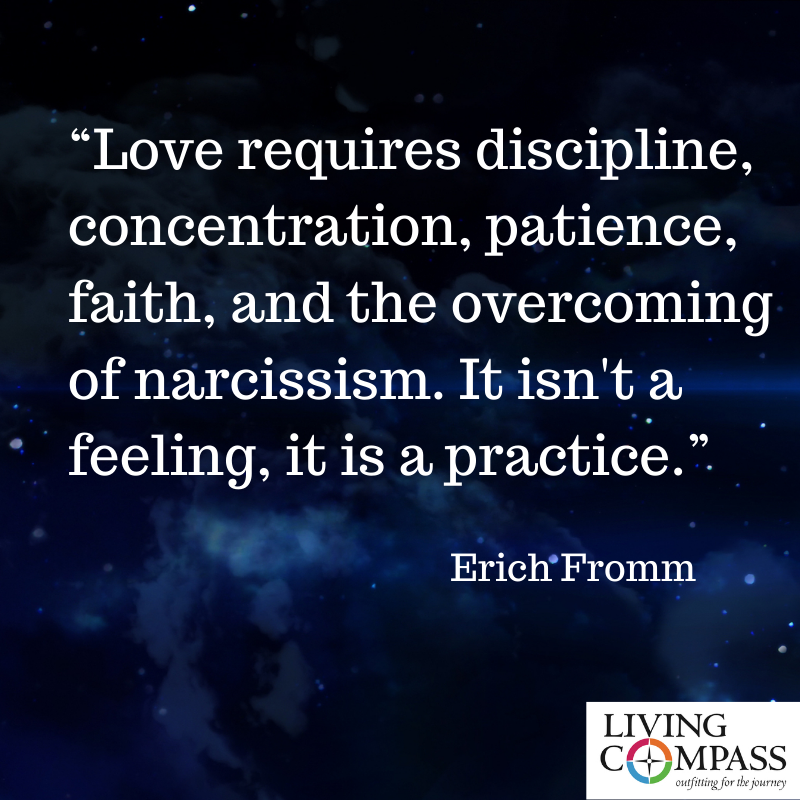
It is common to think of love as a feeling one has for another. While feelings are certainly one aspect of love, what I believe, and what I shared in my remarks, is that love is most importantly, a decision. Feelings ebb and flow in all relationships (marriage and otherwise), and yet the decision to act with love is a choice that is always possible. If you think of the people that you love and that love you, you will likely realize that the expression of that love has involved countless decisions over time that have expressed kindness, patience, generosity, and hopefulness.

Mark and Jennie chose to have the familiar Biblical text from 1 Corinthians 13 read at their wedding. This simple text, some of the most beautiful words ever written about love, does not speak of love as a feeling, but rather it reminds us of the decisions that one makes to act in specific ways that are the foundation of mature love.

“Love is patient; love is kind;

love is not envious or boastful or arrogant or rude.

It does not insist on its own way;

it is not irritable or resentful;

it does not rejoice in wrongdoing, but rejoices in the truth.

It bears all things, believes all things,

hopes all things, endures all things.”

In my message, I added that not only is this reading a profound description of love, but it can also serve as a relational self-assessment. Think of an important relationship in your life, and then with that relationship in mind, read the passage above with your name or “I” in place of the word love. For me, this would mean, “Scott is patient; Scott is kind; Scott is not envious or boastful or arrogant or rude, …etc.” And then I can ask myself if what I just read is true or not. To whatever degree it is not true, I can then make a decision to change and align my actions more closely with my desire to be all that this passage inspires me to be.

Perhaps there is an important relationship in your life right now that feels stressed and conflicted. How could thinking of love primarily as a decision and not a feeling help you to make some choices that might lead to the renewal and strengthening of that relationship?


Subscribe Now to Weekly Words of Wellness:

Click the button below to signup for the e-mail version of Weekly Words of Wellness. This weekly article can be shared with your community electronically and/or used for group discussion.

You can unsubscribe at any time.

Speaking Love Without Saying a Word

 
Speaking Love Without Saying a Word.png
 

Speaking Love Without Saying a Word

  Throughout the world this past week, churches held special services for the blessing of animals. People young and old brought their pets to the service to have them prayed over and blessed. When I have had the honor to help at these services, I have blessed beloved dogs, cats, hamsters, guinea pigs, birds, fish, and even a few stuffed animals that children lovingly brought with them to church. I have friends who have blessed horses, cows, goats, rats, and snakes!

 The reason these services were happening this week is because it the time of year that churches remember is the Francis of Assisi, otherwise known as St. Francis, who died on October 3, 1226. Francis was well known for his love of nature and of animals, and he regularly preached about the importance of learning to be good stewards of all of God's creation. One saying attributed to Francis appears in the quote box above: “Preach the Gospel always. When necessary, use words.” This saying seems perfect for a pet celebration because of the ways our pets embody love without ever saying a word.  

  One of the things I loved most about blessing peoples' pets, was that when they introduced me to their pets and told me a little bit about their special animals, it provided a window into their souls. Pets have a way of touching our souls and bringing out the very best in us, and so it only seems right to have a service for blessing pets. A gathering of pets and their human families for a special celebration is simply a way to celebrate the way in which pets enrich our lives every day.

  Our pets give back to us in so many ways. Author Matthew Fox wrote how his dog was his spiritual director and that he had learned many valuable lessons about how to live well from his dog. In that spirit, I conclude this week's column with a list of 20 things we can learn from a dog. 

Twenty Things I Learned From My Dog

  1. Never pass up the opportunity to go for a joyride.

  2. Allow the experience of fresh air and wind in your face to be pure ecstasy.

  3. When loved ones come home, always run to greet them.

  4. When it's in your best interest, practice obedience.

  5. Let others know when they have invaded your territory.

  6. Take naps and stretch before rising.

  7. Run, romp, and play daily.

  8. Eat with gusto and enthusiasm.

  9. Be loyal.

  10. Never pretend to be something you are not.

  11. If what you want lies buried, dig until you find it.

  12. When someone is having a bad day, be silent, sit close and nuzzle them gently.

  13. Thrive on attention and let people touch you.

  14. Avoid biting when a simple growl will do.

  15. On hot days, drink lots of water and lay under a shade tree.

  16. When you're happy, dance around and wag your entire body.

  17. No matter how often you are scolded, don't buy into the guilt thing and pout, . . . . run right back and make friends.

  18. Bond with your pack.

  19. Delight in the simple joy of a long walk.

  20. Long after you are gone, remain a memory in people’s dreams.


   Even if we do not currently own a pet, or did not attend a special pet service this week, we can all take some time to notice the animals around us and be grateful for their innumerable blessings.


Subscribe Now to Weekly Words of Wellness:

Click the button below to signup for the e-mail version of Weekly Words of Wellness. This weekly article can be shared with your community electronically and/or used for group discussion.

You can unsubscribe at any time.

Of Grief and Gratitude

 
New Weller MEme Grief.png
 

Of Grief and Gratitude

   I have had several conversations with people about my column from last week, where I wrote about how the season of fall reminds us that loss and letting go are a natural and inevitable part of life. A couple of people said this is precisely why they don't like fall because it does remind them of loss. I understand that because feeling the sadness we have about the losses we have experienced is never easy. A question I often get as both a pastor and therapist is some version of, "Do I really have to talk about and feel my sadness and grief, or is it best to just try not to think about it, in hopes that it will go away on its own?"  

  Take a moment and think about the people in your life who you think of as wise, the people who you might describe as "old souls." I know for me, the people I think of in this way, are also people who have been through a lot and have come out the other side wiser and deeper, both emotionally and spiritually. They have been through hard times, including challenge and loss, and have emerged more grateful and wiser about life.  

  So while none of us desires experiences of grief and loss, they are, of course, inevitable. Our only choice is how we will carry them.

  Francis Weller, a well-respected psychotherapist and grief expert, says all of this much better than I am saying it here. And so I will close with a long quote from him, the same one that is found in the box above. May his wisdom help us to see that it is in the way we carry our losses that enhances our capacity for compassion and gratitude.  

"The work of the mature person is to carry grief in one hand and gratitude in the other and to be stretched large by them. How much sorrow can I hold? That's how much gratitude I can give. If I carry only grief, I'll bend toward cynicism and despair. If I have only gratitude, I'll become saccharine and won't develop much compassion for other people's suffering. Grief keeps the heart fluid and soft, which helps make compassion possible." 


Subscribe Now to Weekly Words of Wellness:

Click the button below to signup for the e-mail version of Weekly Words of Wellness. This weekly article can be shared with your community electronically and/or used for group discussion.

You can unsubscribe at any time.
A Symphony of Permanence and Change

 
A Symphony of Permanence and Change
 

A Symphony of Permanence and Change

   The autumnal equinox, one of the days we experience equal amounts of darkness and light, occurred this week, ushering in one of my favorite seasons. I love the season of fall and not just because I enjoy football, apple picking, the stunning colors of the changing leaves, the World Series, Halloween, and Thanksgiving. I also love fall because it is a time when I find myself turning inward, reflecting on the changing nature of life in general, and my life in particular. The poet Bonaro Overstreet says that autumn is "a symphony of permanence and change." Turning inward to reflect on what has changed, or what is changing, also provides the opportunity for me to focus on that which is changeless, that which is permanent.

   Fall is a time of transition. It's not just the trees that are transitioning here in the northern hemisphere, the geese and other wildlife are preparing for the coming winter months as well. The geese as well as  other animals move great distances, making an external, literal transition of place. Trees and other animals, stay and create an internal transition as they shift their energy from external growth and creation to various expressions of internal protecting and stewarding.

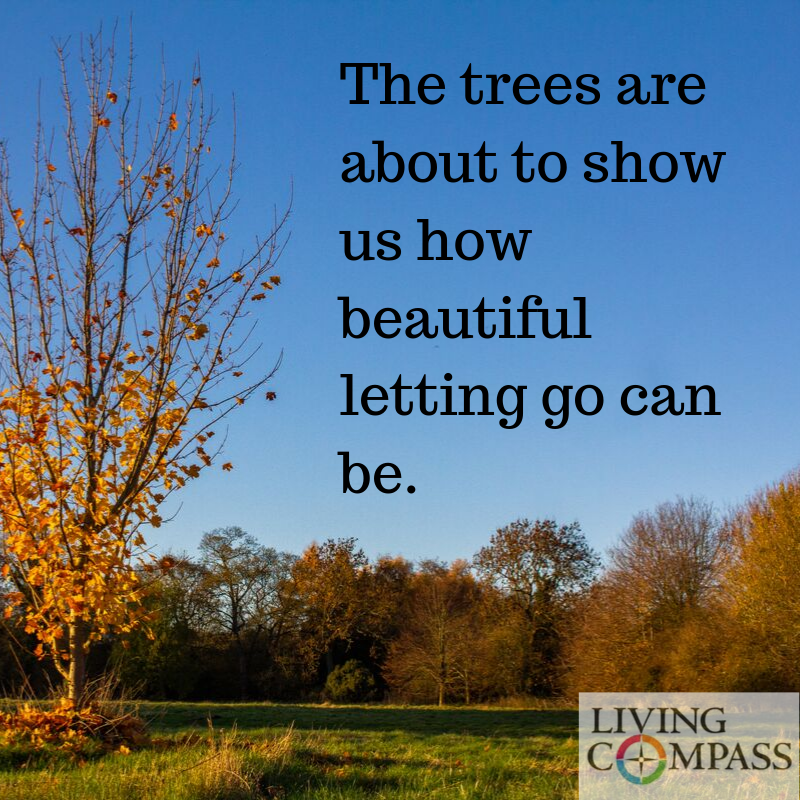
   I find that I too benefit from doing a similar kind of internal transitioning in the fall, as I both let go of what has been, and hold fast to what remains, learning to be appreciative of both. As the quote in the box above conveys so well, "The trees are about to show us how beautiful letting go can be."

   Our lives indeed are comprised of equal parts light and shadow, a balance of day and night, an ongoing "symphony of permanence and change.” As we begin the transition of this season, may we embrace the wisdom of knowing that even in letting go we can find beauty.  


Subscribe Now to Weekly Words of Wellness:

Click the button below to signup for the e-mail version of Weekly Words of Wellness. This weekly article can be shared with your community electronically and/or used for group discussion.

You can unsubscribe at any time.