Just One More Story, Please

 
Just One More Story, Please
 

Just One More Story, Please 

 Our grandchildren are enchanted by stories, something that is hardly surprising given their parents' love for books.  At five and two years old it seems as though they are up for reading and listening to a story almost any time of day or night. There is only one challenge in reading stories with them, and that is finding a way to end the story time as the two cutest children in the universe (I know I might be a bit biased) plead "Read it again," and "I want to hear just one more story, plea............se........"

   No matter our age, we are story loving people. Our identity is formed and shared in and through stories. I have met with friends that I had not seen for quite a while several times in the last few weeks.  How did we choose to reconnect?  We reconnected by sharing coffee and stories.  We shared stories about what we've been up to since we talked last.  We shared stories about what the people we love have been up to as well.  "Tell me one more story" is not just the request of a child who doesn't want to go to sleep, it is also the request we all make of one another when we truly want to connect.

   Holocaust survivor, author, and human rights activist Elie Wiesel wrote about the power of stories in a preface to his novel, The Gates of the Forest.

   "When the great Rabbi Israel Baal Shem-Tov saw misfortune threatening the Jews it was his custom to go into a certain part of the forest to meditate. There he would light a fire, say a special prayer, and the miracle would be accomplished, and the misfortune averted. Later, when his disciple, the celebrated Magid of Mezritch, had occasion, for the same reason, to intercede with heaven, he would go to the same place in the forest and say, "Master of the Universe, listen! I do not know how to light the fire, but I am still able to say the prayer," and again the miracle would be accomplished.

   Still later, Rabbi Moshe-Leib of Sasov, in order to save his people once more, would go into the forest and say: "I do not know how to light the fire, I do not know the prayer, but I know the place, and this must be sufficient." It was sufficient, and the miracle was accomplished.

   Then it fell to Rabbi Israel of Rizhyn to overcome misfortune. Sitting in his armchair, his head in his hands, he spoke to God: "I am unable to light the fire, and I do not know the prayer; I cannot even find the place in the forest. All I can do is to tell the story, and this must be sufficient." And it was sufficient.


 God made human beings because God loves stories."

   If you need more evidence of the power of stories, be sure to watch the Academy Awards this Sunday night.  Movies, which are merely stories brought to life on the big screen, undoubtedly play an influential role in our culture.  They inspire us and get us talking with one another.  They entertain us and distract us from the stresses of everyday life.  They bring couples, families, and friends together to create a shared experience, not just in viewing the movie together, but in discussing and replaying the experience for hours and days afterward.

   What are the favorite stories of your life? What are your favorite books, plays, and movies? What do your favorites say about you and about what is most important to you? What do they say about your core values and beliefs? The next time you are with a friend, discuss your answers together, and you will most likely learn something new about each other.  

   But be warned, once you get started sharing some of your favorite stories, it might just be hard to stop when one of you pleads, "I want to hear just onemore story plea......se......"


Subscribe Now to Weekly Words of Wellness:

Click the button below to signup for the e-mail version of Weekly Words of Wellness. This weekly article can be shared with your community electronically and/or used for group discussion.

You can unsubscribe at any time.
Be an Encourager

 
Be an Encourager
 

Be an Encourager

This past weekend I watched the Grammy awards and couldn’t help but notice a pattern. Many of the winners started their acceptance speeches with some version of, “I just want to thank ______ for encouraging me to believe in myself, or take a risk, or be true to myself, to never give up….” The implication is that without the encouragement they are referencing, they might never have been able to accomplish what they did.

Most of us will not ever find ourselves giving an acceptance speech in front of millions of viewers, but most of us have received the gift of someone who has encouraged us. Pause for a moment and bring to mind someone who encouraged you at some point in your life. Do you remember what they said? Perhaps not, but you likely remember the spirit of what they said, and how much it boosted your confidence and self-esteem.

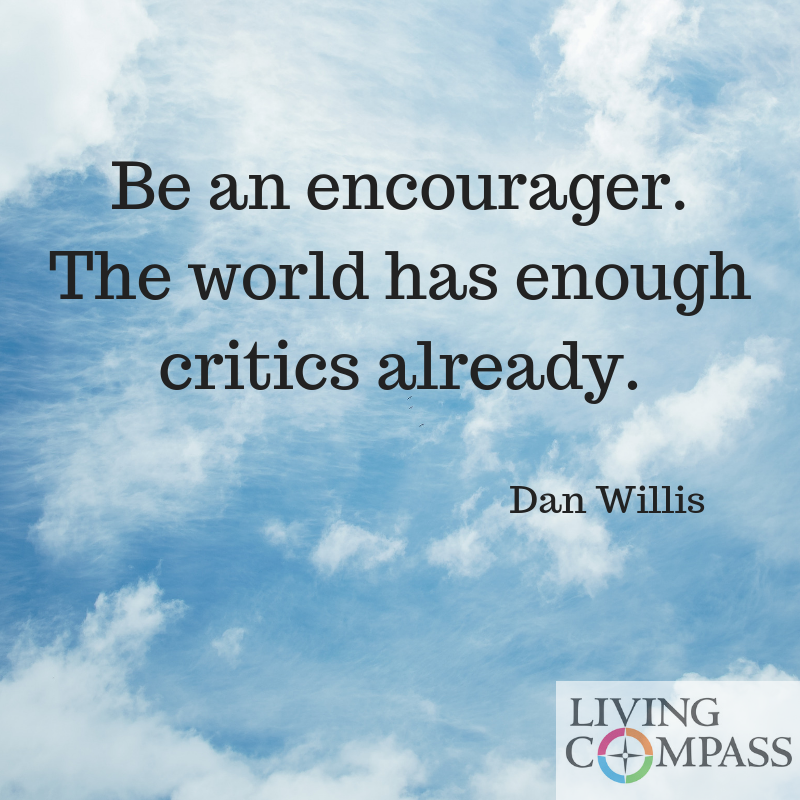
The first three words in the quote in the box above by Dave Willis are so simple that it would be easy to miss their power. Be an encourager. I have already noted the significant impact encouragement has on people in the frequency with which its power is referenced in the award speeches at the Grammys. Offering encouraging words to your child, partner, friend, colleague, family member, or even a stranger, is so simple do to and yet we can often immediately see their positive effect.

In light of the celebration of Valentine’s ay the week, we have all seen countless images of hearts, including some version of the popular graphic that has the word “I” followed by a heart, which is then followed by the word you.

While the obvious meaning of this is “I love you,” it can also be interpreted as a perfect representation of the words, “I encourage you.” This is because the word “courage” derives from the same root as the Latin word for heart, “cor,’ and in Old French, the word “corage.” The prefix “en” means “to cause to be in,” or “to put in” and so together to encourage another person literally means to put heart into that person.

So who do you know that could use a little encouragement right now? What could you say or do that could put some heart into their lives? Your encouragement might not lead to their winning a Grammy someday, but I guarantee it will add some sweet music to their lives in the present moment.


Subscribe Now to Weekly Words of Wellness:

Click the button below to signup for the e-mail version of Weekly Words of Wellness. This weekly article can be shared with your community electronically and/or used for group discussion.

You can unsubscribe at any time.
Change is Inevitable. Growth is Optional.

 
Change is Inevitable. Growth is Optional.
 

Change is Inevitable. Growth is Optional.

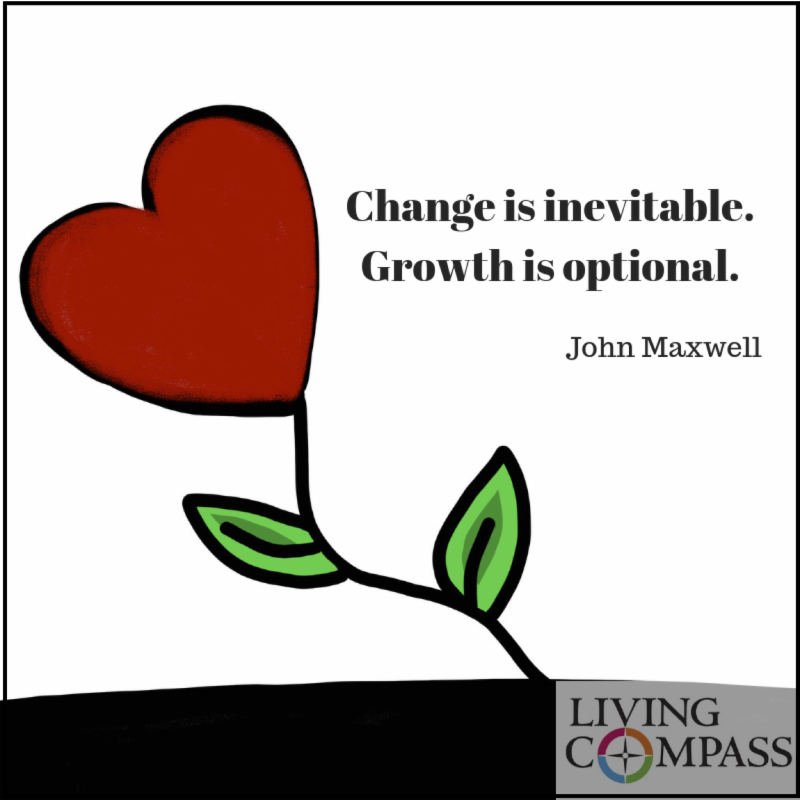
The above quote, "Change is inevitable. Growth is optional" from author John Maxwell, is one of my favorites. Maxwell writes leadership books and so it is natural that the wisdom of this quote is often applied to organizations and businesses. In honor of Valentine's Day approaching, though, I would like to reflect on its meaning as it pertains to love and relationships.  

All relationships change, because change is inevitable. This is true of all relationships, whether they be with family, friends, or if they are romantic. While every relationship experiences change over time, not all relationships experience growth. Why? Because, as the Maxwell quote says, growth is optional. Growth only happens when both people in any relationship are committed to the ongoing emotional and spiritual growth that a mature relationship requires.  Growth occurs when both people can see conflict and difficult times simply as occasions and opportunities for growth and for learning new individual and relationship skills.  What does a committed student do when they come up against a problem they don't understand or can't solve? They work harder to figure it out, and in the process, they grow in their skill and knowledge. The same is true when both people in a relationship are willing to treat problems as opportunities to gain new knowledge and skills.  

One of my favorite bits of wisdom to share when counseling young couples is that love is much more than a feeling and that actually, love is primarily a decision.  It is so important to remember this in the midst of the constant images and messages we get through television and movies that focus primarily on love as a feeling. If love is primarily about feelings, then what do we do when the feelings naturally ebb and flow? Understanding that mature love is a decision is what helps us commit to persevering and growing, especially when we are experiencing challenges in our relationships and are not currently experiencing a lot of the feelings of love.   

Imagine a person walking into their local gym and saying to a personal trainer, " I want to get stronger, more flexible, and overall just get in better shape." The trainer would, of course, respond that they could help with that. Now imagine, the person added, "And I would like to receive these results without having to work at it, without feeling any discomfort as part of the process." It is easy to see that this is not going to work. When it comes to relationships, if the two individuals in the relationship want the feelings of love without committing to the decision to do the work, it is bound to fail. All significant relationships require both people committing to working on the relationship, in order for it to grow and mature.  

Change is inevitable. We don't have to make a decision for change to happen. It happens with or without our consent. Growth is what is optional, it only happens with our consent and when we make the decision to grow. 

While this wisdom is true for organizations and businesses, let's remember, in honor of Valentine's Day, that it is also true for all of the significant relationships in our lives. 


Subscribe Now to Weekly Words of Wellness:

Click the button below to signup for the e-mail version of Weekly Words of Wellness. This weekly article can be shared with your community electronically and/or used for group discussion.

You can unsubscribe at any time.

Stay Warm

 
Stay Warm
 

Stay Warm

Most of my interactions with both friends and strangers this week here in the frozen Upper Midwest have ended with the same two words. Whether checking out at the grocery store or coffee shop, talking on the phone, or exchanging emails, the most commonly shared words of the week have been, "Stay warm."  For fun, I started counting how many times I have either said or heard these words, and as I write this it's been eleven times already just today, and it's only mid-afternoon.  Given that the temperature the past few days has reached 25 below zero here several days in a row, exchanging a reminder to "Stay warm" seems only appropriate. 


For the record, I really don't like bitter cold weather. I get really cranky when it's too cold to spend time outside. I get cranky when I have to constantly shovel and spread salt on our sidewalk. I get cranky when my furnace acts up, as it has this week. I get cranky when the fitness center we belong to is closed for most of the week (it is connected to our local high school and closes when school is canceled, as it has been the last three days). I get cranky when meetings get canceled due to cold or snow, and when the mail is cancelled, too. And, yes, I understand that's a lot of crankiness!


So in the midst of my episodes of crankiness this week, I suddenly realized I was receiving a regular message throughout the day of how to manage my moodiness. This message was hidden in plain sight, but when I realized it, it truly made a difference.  It happened a few days ago when someone once again uttered the words, "Stay warm" to me. For some reason, this time I heard those words in a whole new way. Rather than hearing them as reminding me to make good choices related to my physical well-being, I instead started hearing the words, "Stay warm" as a reminder for me to make good choices related to my emotional well-being.  


I have learned that staying warm emotionally is the perfect antidote for crankiness. I realized that just because its cold and stormy outside doesn't mean I have to be cold and stormy inside. Not that I don't still suffer short bouts of crankiness, but the very fact that I have set the intention to try and "Stay warm" is making a big difference. 


I am grateful that the forecast in our area for the next few days is for much warmer weather.  And while I may not be grateful for the extreme cold we have recently endured, I am thankful for the simple two-word lesson that so many people shared with me this week. 


You have probably already anticipated how this column is going to end..... "Stay warm" everyone.


Subscribe Now to Weekly Words of Wellness:

Click the button below to signup for the e-mail version of Weekly Words of Wellness. This weekly article can be shared with your community electronically and/or used for group discussion.

You can unsubscribe at any time.
Coming Alive Through Small Acts of Kindness

 
Coming Alive Through Small Acts of Kindness
 

Coming Alive Through Small Acts of Kindness

My friend Matt Gunter, the Bishop of the Episcopal Diocese of Fond du Lac, Wisconsin, recently posted the story below on his Facebook page. He had received the story from a friend of his, and now it's my turn to share it with you. Its message is too beautiful not to be shared. I hope you agree, and will, in turn, share it with others. 


Howard Thurman sat on a train platform in his hometown of Daytona, Florida in 1915, crying his heart out. His family had raised enough money to send him to school, but he didn't have enough money to pay special shipping for his borrowed steamer trunk, which the ticket agent had just told him was too shabby and fragile to transport as regular baggage.


There were no schools for black children like Howard beyond 7th grade in Daytona, and to be unable to go to Florida Baptist Academy in Jacksonville would be the end of this brilliant young man's dreams. "Presently I opened my eyes and saw before me a large pair of work shoes. My eyes crawled upward until I saw the man's face. He was a black man, dressed in overalls and a denim cap. As he looked down at me, he rolled a cigarette and lit it. 


Then he said, "Boy, what in hell are you crying about?"

And I told him.


"If you're trying to get out of this damn town to get an education, the least I can try to do is help you. Come with me," he said.

He took me around to the agent and asked: "How much does it take to send this boy's trunk to Jacksonville?"


Then he took out his rawhide money bag and counted the money out. When the agent handed him the receipt, he handed it to me. Then, without a word, he turned and disappeared down the railroad track. I never saw him again."


Thurman got to Jacksonville. His battered old steamer trunk got there too. He grew up to be "an influential African American author, philosopher, theologian, educator and civil rights leader. He was Dean of Chapel at Howard University and Boston University for more than two decades, wrote 21 books, and in 1944 helped found a multicultural church. Thurman, along with Mordecai Johnson and Vernon Johns, was considered one of the three greatest African-American preachers in the early 20th-century." (Wikipedia)


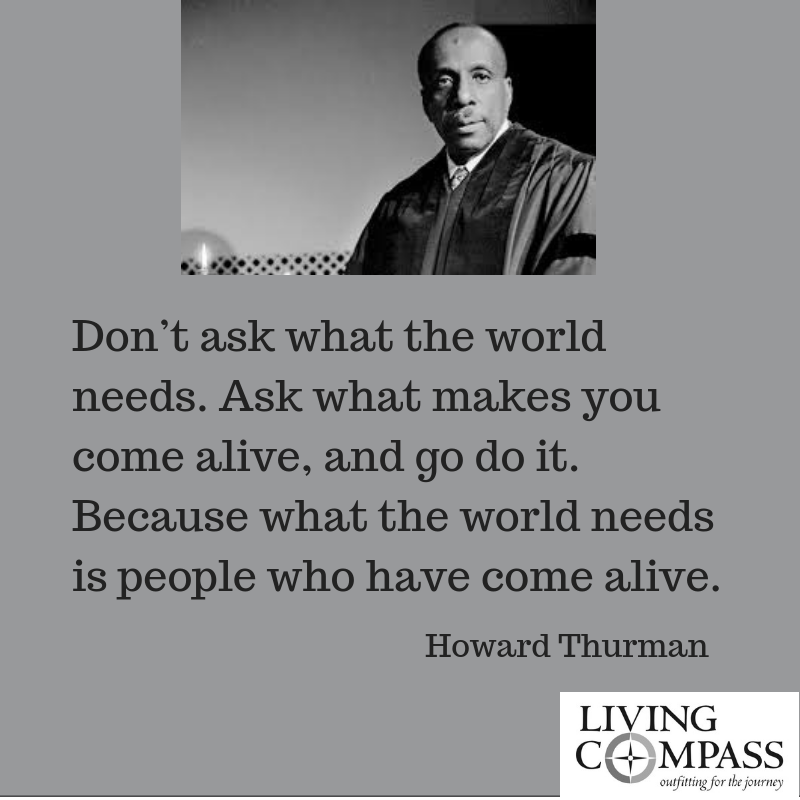
He was very close friends with an Atlanta preacher named Martin Luther King and a he became a lifelong friend and mentor to Martin Luther King, Jr. One of his most well-known quotes about the world needing more people who have come alive appears with his photo in the box at the top of this column.


We cannot know how much influence even the smallest act of kindness can have. Very few people will ever be a Howard Thurman. Even fewer will ever be a Martin Luther King, Jr. - but every single one of us, everyone, can be that man at the train station.

So what small act of kindness might we do for another today, something that just might help us and/or them to come alive? 


The story of what happened to Howard Thurman at the train station is told by him in, With Head and Heart, the Autobiography of Howard Thurman.


Subscribe Now to Weekly Words of Wellness:

Click the button below to signup for the e-mail version of Weekly Words of Wellness. This weekly article can be shared with your community electronically and/or used for group discussion.

You can unsubscribe at any time.