Do You See? Do You See?
First Sunday in Lent
Reflection By Brian Cole
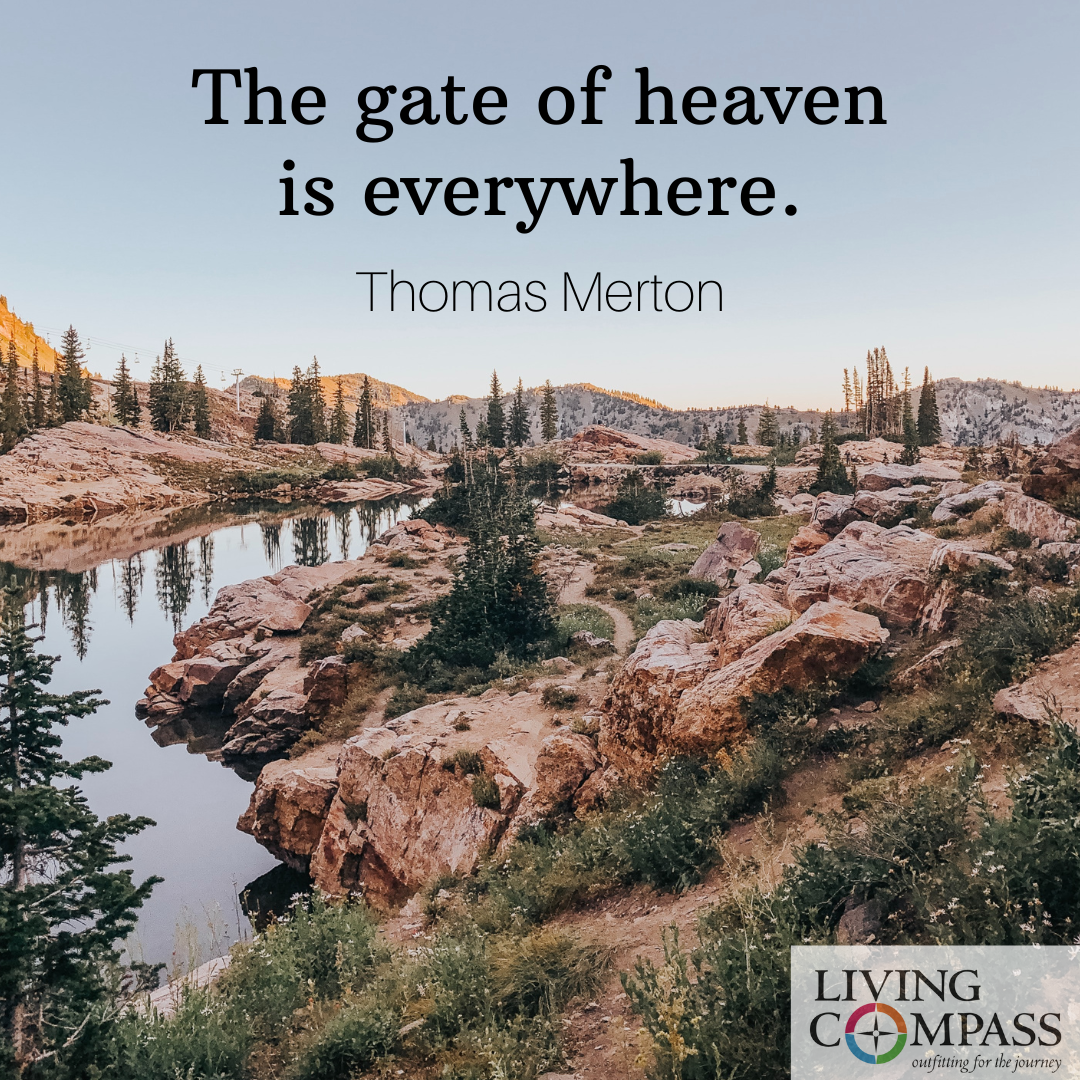
The gate of heaven is everywhere.
- Thomas Merton
A group of us is gathered on the front porch of Thomas Merton’s hermitage at the Abbey of Gethsemani near Bardstown, Kentucky. From the monastery guesthouse, our small group walked in silence to the late monk’s hermitage to sit and pray. For nearly an hour, we sat in straight back chairs, facing the same field that Merton saw from his writing desk.
At the conclusion of silent prayer, Brother Paul Quenon, who guided our group into the woods where Merton’s hermitage is hidden, begins speaking. He is telling us stories of Thomas Merton’s years as Novice Master, when he was shaping monastic life for young monks like Brother Paul. Brother Paul entered the monastery in 1958. Like so many young monks, he had read Merton’s autobiography, The Seven Storey Mountain, and been changed by it. Now, the young monk was being guided by the famous writer.
As he spoke about the essence of Merton’s monastic teachings, Brother Paul also mentioned a kind of verbal tic that his Novice Master possessed. Over the course of a teaching, Merton would often pause and say, “Do you see? Do you see?”
The young monks were being taught by someone able to guide them faithfully toward a oneness with God. As he did so, Merton’s question regarding sight was a kind of invitation to awareness, an opportunity to assess understanding. Brother Paul did not tell us if any young novice ever responded to Merton’s ongoing question about seeing.
“Do you see? Do you see?”
When Jesus heals a blind man at Bethsaida, we see a gradual miracle (Mark 8:22-26).The exchange between Jesus and the blind-becoming-less-blind-becoming-full-sighted man is a loving and honest one.
In healing the man, Jesus asks him what has changed. The man is honest, letting Jesus know his sight is improved, though also noting that trees do not tend to walk about. More than an honest response, the half-seeing man is measuring the healing that has taken place and praying for more healing to emerge.
Notice that Jesus does not blame the man for his response, suggesting that if he had more faith, his sight would be perfect. Rather, Jesus touches him again. Then, with another touch, another change, more time, the man can see clearly.
The one-stop, one-fix, one-moment experience of healing, spiritual maturity, and utter transformation is something too many of us chase, often because somewhere someone has told us that is the quest. Yet, if that were the whole point, then would not Lent last for only half a day rather than a season of week upon week?
Growth toward wholeness in the real world where you and I live, where we fall and get back up, is one in which our vision is being corrected more than once. Over time, what was not clear becomes more so. What was blurry comes into focus. A loving guide asks, “Do you see?” They are prepared to receive your honest response. What has changed? What still needs attention?
The path to wholeness and healing in the spiritual life invites us to move, to look and see as we move, to keep on moving, to keep on looking. Over time, through the grace of God, we come to know the path as our path, and we begin to discern the trees from the people.
We remain on the porch for a while. The field is still there, ordinary in its stillness—the trees rooted, the light shifting a little. Our sight was not perfect; it almost never is. But we could say a bit more about what had changed, and what was still shadowed and veiled. And we could trust that Jesus would ask again, as he once asked in Bethsaida, “What do you see?”