"Taking Time to Reset," November 7, 2025


Taking Time to Reset

The Wellness Compass Initiative is our partner community wellness initative that serves schools, counseling centers, nonprofits, universities, and other community wellness organizations. Each week Holly Hughes Stoner and Scott Stoner, who are both licensed marriage and family therapists, co- write a column for Wellness Compass and we are pleased to share it here on our Living Compass site. There is also a Wellness Compass podcast, where Scott and Holly elaborate on the topic of this column each week, at www.wellnesscompass.org/podcast. or in any podcast app (Apple, Google, Spotify, etc).

Taking Time to Reset

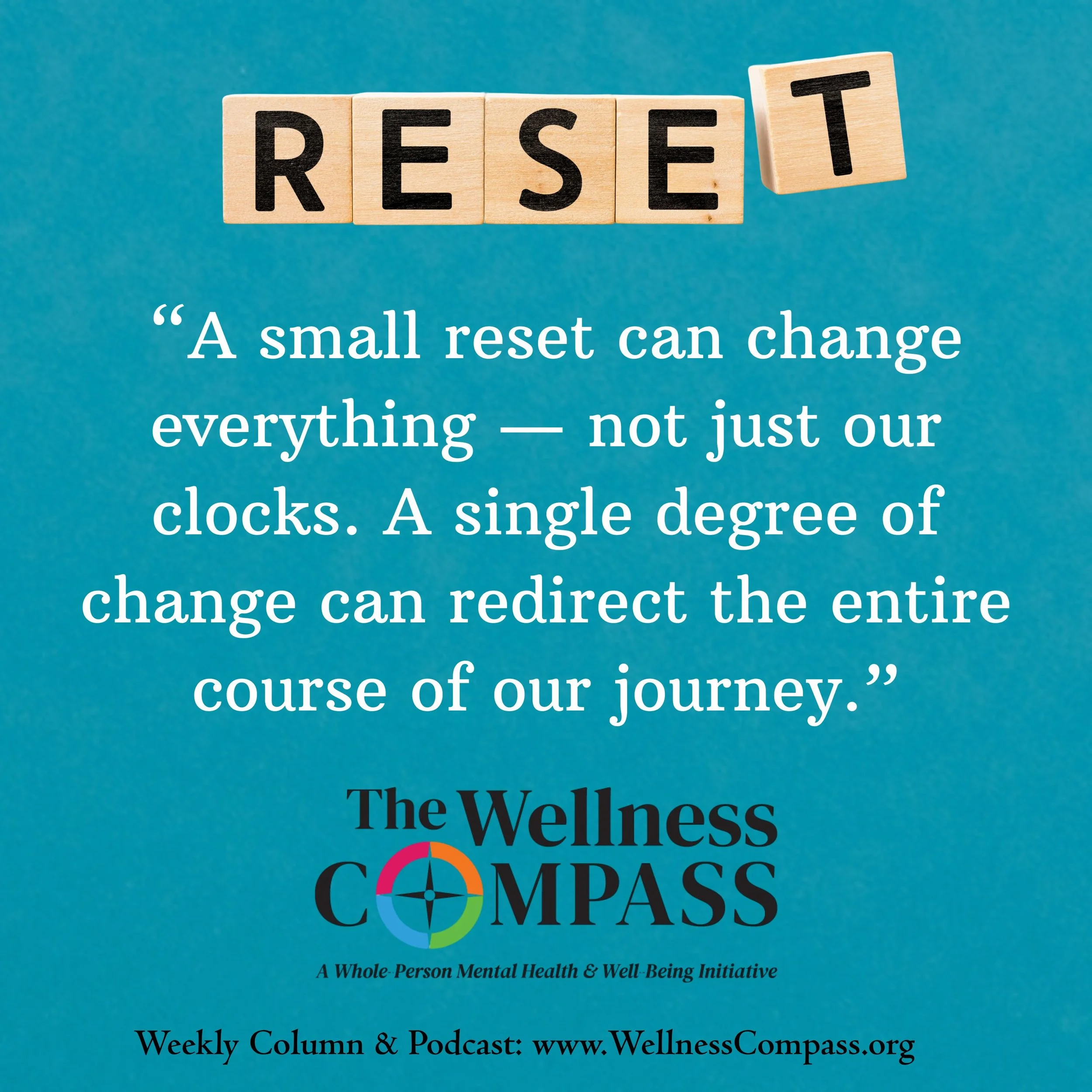
Having just reset our clocks this week, we know that this simple adjustment—moving backward by a single hour—can change our entire rhythm. For some, the change was not a big deal; for others, it is still affecting their sleep schedules (or those of their kids or pets). But here's the good news: within a few days, most of us recalibrate and adapt.

This semi-annual ritual reminds us that the power of a small reset can change our perspectives. When we consciously shift our perspectives, we can transform our experience of life just as dramatically as changing our experience of the sun rising and setting.

Small Shifts Can Create Big Changes

The key is recognizing that our perspectives are a choice. When we feel stuck, we often think our external situation must change before we can feel different. But what if the "reset" we need isn't in our circumstances but in how we're looking at them? A relationship conflict might shift when we stop asking "who's wrong?" and start asking "what does this relationship need?"

We have all had the experience of negatively judging someone's behavior, and then shifting our reaction from judgment to compassion when our perspective changed with additional information about why a person is acting the way they are. 

Perspective Shapes Experience More Than Facts Do

Two people can experience the same time change and have entirely different perspectives. One embraces the earlier sunrise while the other curses the earlier sunset. Another person is irritated because they believe the government should end daylight saving time altogether. 

Our brains are meaning-making machines, constantly interpreting and narrating our lives. Two people receive the same email from their boss that offers constructive feedback. One person finds the email helpful and motivating. The other finds it demoralizing and shaming. All of our experiences are filtered through our perspective. It's been said that we don't see things as they are, but often we see them as we are. This is why checking out our perspectives with others can be helpful, rather than assuming they are always accurate and useful. 

Resistance to Resetting Keeps Us Stuck

Mindset, a popular bestselling book by Carol Dweck, outlines the crucial difference between a fixed and a growth mindset. A growth mindset is characterized by an openness to changing and resetting our views and perspectives. A fixed mindset is just what it sounds like—its motto is, "but I/we have always done it this way." Resistance to resetting our perspectives rarely serves us well, and almost always impedes growth. 

In our world today, changing one's perspective is often seen as a weakness. Nothing could be further from the truth. As we grow and mature and gain new information and experiences, it is only natural for our perspectives to shift. And even if the shift is slight, like a ship changing its bearing just a few degrees, that small change will create a larger shift over time. 

Readjusting Is an Ongoing Practice

We don't reset our clocks once in a lifetime. Similarly, perspective shifts aren't one-time events but ongoing practices. Our go-to viewpoints reassert themselves, old patterns return, and we need to consciously see if it's time to readjust again and again.

This isn't failure—it's being human. The practice is in noticing when we've drifted back into unhelpful perspectives and gently adjusting our compass. Each time we do this, we strengthen our ability to shift. We become more fluid, more resilient, more capable of meeting life's challenges with creativity, rather than rigidity. 

Making It Personal:

1. Where in your life have you been holding a fixed mindset that could benefit from greater openness to growth? What slight shift could you make this week?

2. Think of a situation where you are harshly judging a friend, family member, or colleague's behavior. Might a shift in perspective open you to softening your judgment and feeling empathy or compassion? 

3. Can you think of a time when shifting your perspective regarding how you viewed yourself, a situation, and/or another person created an opportunity for moving from being stuck to experiencing new possibilities? What can you learn from that?


Subscribe Now to Weekly Words of Wellness:

Click the button below to signup for the e-mail version of Weekly Words of Wellness. This weekly article can be shared with your community electronically and/or used for group discussion.

You can unsubscribe at any time.

Sign Up

"What the Day of the Dead Teaches Us About Emotional and Family Wellness," October 31, 2025


What the Day of the Dead Teaches Us About

Emotional and Family Wellness

The Wellness Compass Initiative is our partner community wellness initative that serves schools, counseling centers, nonprofits, universities, and other community wellness organizations. Each week Holly Hughes Stoner and Scott Stoner, who are both licensed marriage and family therapists, co- write a column for Wellness Compass and we are pleased to share it here on our Living Compass site. There is also a Wellness Compass podcast, where Scott and Holly elaborate on the topic of this column each week, at www.wellnesscompass.org/podcast. or in any podcast app (Apple, Google, Spotify, etc).

While Americans are having fun celebrating Halloween this week, other countries around the world, especially in Mexico and Latin America, will be celebrating El Día de los Muertos (Day of the Dead). Our love for Mexico is immense, as we have traveled there many times for both fun and service projects. In honor of El Día de los Muertos, we are going to share four wellness compass points we can all learn from this centuries-old tradition, which provides guidance for living with loss and strengthening family bonds.

Grief Doesn't Have an Expiration Date

Modern culture often treats grief as something we are supposed to get over—we're expected to "move on" or find "closure" within socially acceptable timeframes. Day of the Dead rituals cultivate a very different relationship with death. By creating tables in the home filled with photos, favorite foods, and cherished objects of loved ones who have passed away, families acknowledge that love doesn't end at death. Research on grief now affirms that maintaining connections with deceased loved ones is healthy and adaptive. Setting a place at the table, cooking grandmother's recipe, or simply speaking to those we've lost isn't denial—it's integration. This tradition normalizes ongoing relationships with the dead, removing the shame many feel when grief continues to be felt.

Collective Remembering Heals Isolation

Grief can be profoundly lonely, especially in cultures where discussing death feels taboo. Day of the Dead traditions transform mourning from private suffering into communal celebration. Families and friends gather in cemeteries, not with somber silence but with music, food, and storytelling, normalizing everyone's pain while reminding us we're not alone in it. Sharing memories, laughing through tears, and sometimes resolving conflicting stories about complicated relatives can help ease the pain, as everyone is allowed to express sadness openly.

We Can Hold Joy and Sorrow Simultaneously

Perhaps the most striking aspect of El Día de los Muertos is its refusal to make grief only somber, as the day is also a fiesta of celebration. This isn't minimizing loss but rather honoring the fullness of life, including its ending. Families laugh while remembering funny quirks of the deceased, celebrate their loves and passions, and acknowledge their humanity with both fondness and honesty. It teaches that healing doesn't mean forgetting, and remembering doesn't require constant sorrow.

Rituals Provide Structure for Difficult Emotions

Grief often feels overwhelming because it's formless. Day of the Dead traditions offer concrete actions: gathering flowers, preparing specific foods, visiting the cemetery, and arranging an altar with reminders and possessions of the loved one. These rituals create containers for big emotions, making them more manageable. Creating annual traditions around remembrance gives families something to do with their love and longing, transforming passive sadness into active honoring.

As we navigate the losses in our own lives, El Día de los Muertos reminds us that the healthiest approach to loss and death isn't avoidance but integration—weaving our loved ones into our ongoing story with both tears and laughter.

Making It Personal

1. Have you ever felt pressure to "move on" from a loss or difficult emotion before you were ready? What would it look like to give yourself permission to grieve without a timeline?

2. Think of someone you've lost who still influences your life. What are the small ways you continue to honor or maintain a connection with them? How does keeping their memory alive bring you comfort or guidance?

3. What ritual or concrete action could you create to honor someone you've lost or to process difficult emotions? This could be cooking a special meal, visiting a meaningful place, or creating a small tradition. How might having this structure help contain and express what feels overwhelming?


Subscribe Now to Weekly Words of Wellness:

Click the button below to signup for the e-mail version of Weekly Words of Wellness. This weekly article can be shared with your community electronically and/or used for group discussion.

You can unsubscribe at any time.
Sign Up

"Making the Problem the Problem, Not the Person," October 24, 2025


Making the Problem the Problem, Not the Person

The Wellness Compass Initiative is our partner community wellness initative that serves schools, counseling centers, nonprofits, universities, and other community wellness organizations. Each week Holly Hughes Stoner and Scott Stoner, who are both licensed marriage and family therapists, co- write a column for Wellness Compass and we are pleased to share it here on our Living Compass site. There is also a Wellness Compass podcast, where Scott and Holly elaborate on the topic of this column each week, at www.wellnesscompass.org/podcast. or in any podcast app (Apple, Google, Spotify, etc).

We've all been there: a conflict starts small—maybe it's about whose turn it is to handle the dishes or a disagreement about something important you're planning together—and suddenly you're no longer discussing the actual issue. Instead, you're blaming each other for being difficult or stubborn. The conversation has shifted from the problem itself to attacking the other person. This only leads to hurt feelings and damaged relationships, with little progress on actually resolving the challenge at hand.

Here are four "compass points" to help us all work together on challenges we are facing, rather than turning against each other.

The problem is separate from the people working on it.

When we're frustrated or stressed, it's natural to want someone to blame. Our partner didn't take out the trash again, so we label them "irresponsible." Our friend is never as punctual as we are, so we label them as "uncaring" or "absent-minded." The moment we make this shift, we've stopped being companions working toward a solution and have become opponents in a battle neither of us can win.

Focusing on the problem creates constructive solutions; blaming people creates defensiveness.

When someone feels attacked, their brain goes into protection mode—they're no longer thinking about solving the issue; they're thinking about defending themselves or counterattacking.

Consider a group of volunteers planning an event for a nonprofit. Half want a large event with a big budget, while the other half want something smaller and less expensive. They can frame this two ways: "Those people are spendthrifts who don't care about our finances" versus "Those people are tightwads too afraid to take risks." Or they could say: "The problem is that we haven't yet come up with a plan that has buy-in from all of us. Let's keep talking and find a recommendation that honors what each of us values.”

Empathy helps us remember that a person's identity is separate from their thoughts and behaviors.

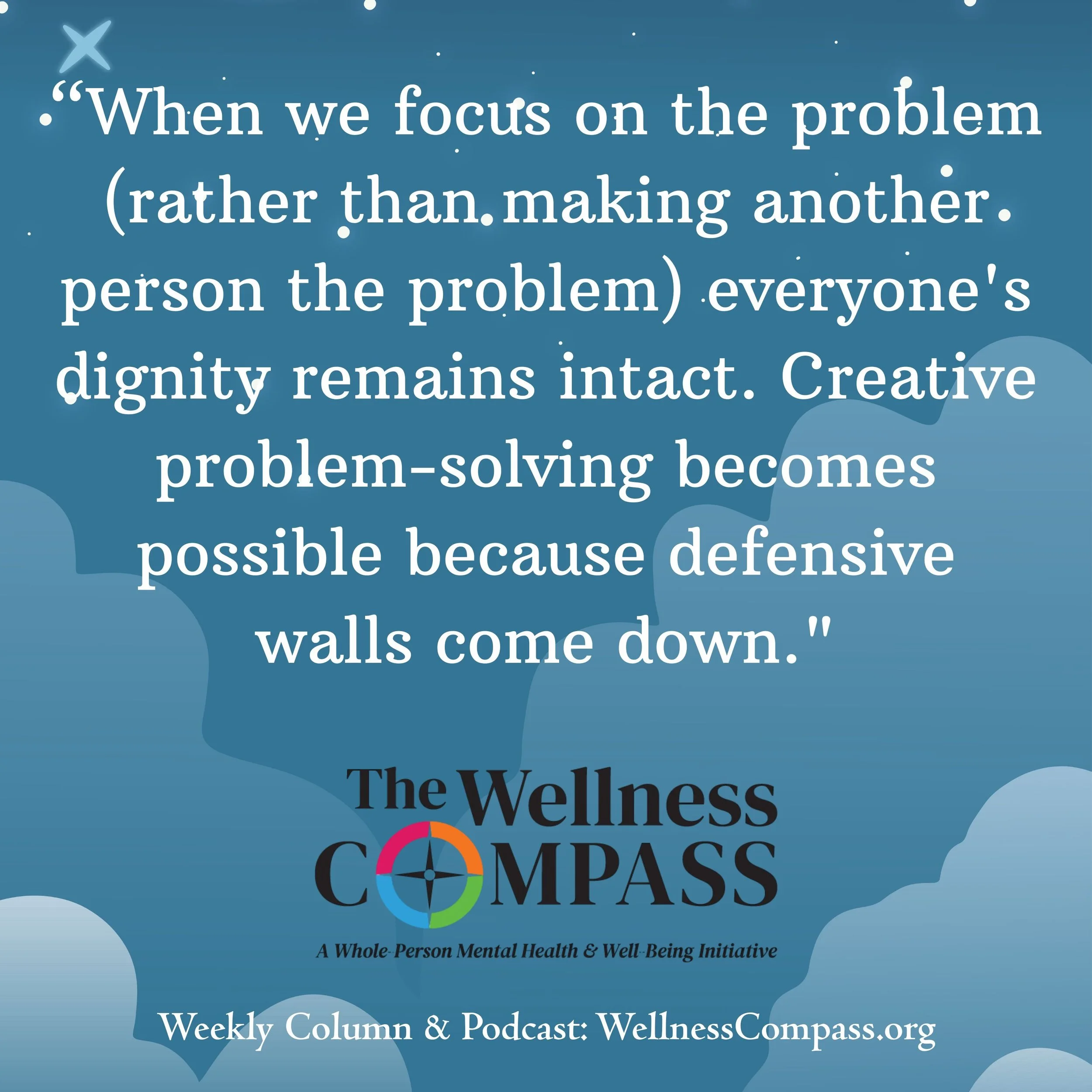
Well-intentioned people often disagree. That doesn't make one person "good" and the other "bad." When we remember this, everyone's dignity remains intact—no one is being labeled or attacked. This means creative problem-solving becomes possible because defensive walls come down, and relationships strengthen because you're reminded you're on the same side.

Sometimes behavior needs to be directly addressed—but still without making the person the problem.

If someone close to us has a drinking problem, for instance, we need to address that behavior directly. But we have a choice in how we approach it. Attacking them and labeling them as an alcoholic is unlikely to help. More effective would be: "We've talked many times about the impact alcohol is having on our life together, and each time it leads to a blowup. I don't like how angry we both get. How about we go together to talk to a professional to help us find a way forward?" Here, the problem is the alcohol and the conflict it creates in their life, not the person.

Making it Personal:

1. Are you stuck in a conflict cycle where you or others are attacking and defending rather than collaborating? How might you shift the focus back to the problem?

2. How does it feel when someone makes you the problem rather than addressing the issue? How might this awareness change your approach?

3. The next time conflict arises, commit to keeping the focus on the problem—not on labeling people.


Subscribe Now to Weekly Words of Wellness:

Click the button below to signup for the e-mail version of Weekly Words of Wellness. This weekly article can be shared with your community electronically and/or used for group discussion.

You can unsubscribe at any time.
Sign Up

"Our Need for Different Kinds of Rest," October 17, 2025


Our Need for Different Kinds of Rest

The Wellness Compass Initiative is our partner community wellness initative that serves schools, counseling centers, nonprofits, universities, and other community wellness organizations. Each week Holly Hughes Stoner and Scott Stoner, who are both licensed marriage and family therapists, co- write a column for Wellness Compass and we are pleased to share it here on our Living Compass site. There is also a Wellness Compass podcast, where Scott and Holly elaborate on the topic of this column each week, at www.wellnesscompass.org/podcast. or in any podcast app (Apple, Google, Spotify, etc).

Our Wellness Compass Initiative is a holistic approach to wellness. With that in mind, we offer four "Compass Points" that speak to multiple dimensions of rest, as well as help us become aware of our inner attitudes about the role of rest in our lives.

1. Physical Rest: It's not just about enough sleep

There are numerous studies on the connection between various diseases and chronic sleep deprivation. "I'll sleep when I'm dead" takes on a new meaning when we fool ourselves into thinking we can ignore the biological basis of needing adequate sleep. Not getting enough sleep affects our mental health and our relationships, too. Irritability is just one symptom of low sleep. Beyond sleep, we will also benefit from restorative practices that nurture our physical well-being, such as walks (when possible), stretching, and yoga.  We only get one body to live in. Being sure it gets enough rest and renewal is essential to our overall well-being.  

2. Mental Rest: Reducing Cognitive Overload

Our minds process thousands of thoughts daily, and the constant demands of decision-making, problem-solving, and listening to or scrolling through the news of the day can create excessive mental fatigue.  Restorative practices for mental exhaustion can include taking a break from the news for a while, making time for meditation, spending time outdoors in nature, or listening to music. When our mind feels foggy or we struggle to concentrate, we are not being lazy—we are experiencing mental exhaustion that requires rest and renewal.

3. Emotional Rest: Permission to Be Authentic and Practice Self-Care

Two primary causes of emotional exhaustion are caregiving for others and being constantly "on" for others, where we don't feel safe expressing our true feelings; instead, we present a facade. Emotional rest can be found when we can balance caregiving with self-care, recognizing that self-care is not selfish. Rest also comes when we have safe spaces—whether it's with trusted friends or family, or perhaps a therapist — where we can drop our masks and authentically share all our emotions.  

4. Become Aware of Our Mindset Regarding the Importance of Rest 

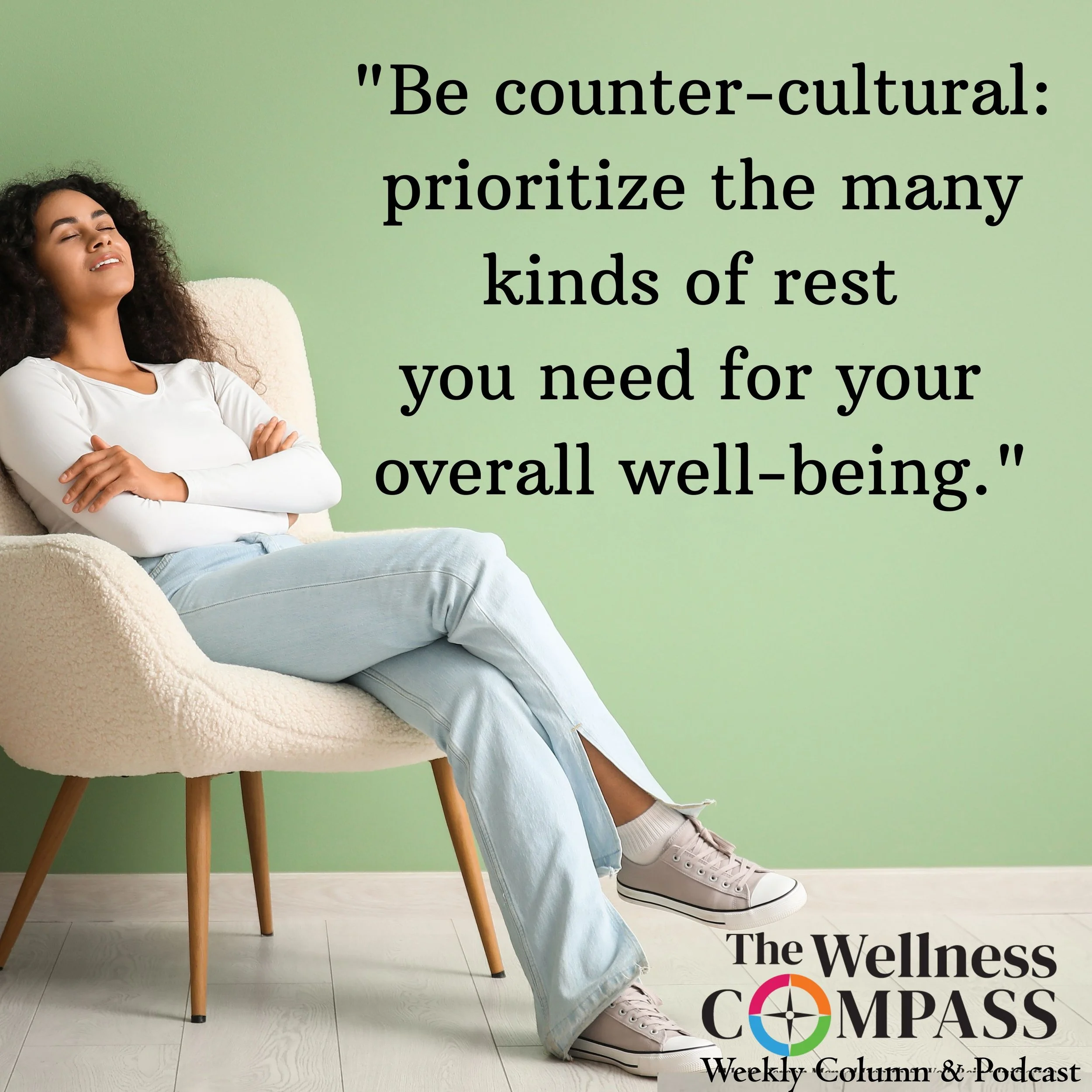
We live in a culture obsessed with busyness, where we are more like human doings than human beings. It hasn’t always been so. Ancient cultures prioritized the importance of sabbath time. At Wellness Compass, we often discuss becoming more aware of the many compasses that guide our habits and behavior—often outside of our conscious awareness. Busyness and an over-identification with achievement and action are inner compasses that sometimes minimize or even ridicule the importance of rest. Being tired much of the time can even be seen as a badge of honor in many circles.  Therefore, it is essential that we surface our own deeper attitudes about rest and recognize that in our fast-paced world, prioritizing rest and self-care may feel counter-cultural. Making this counter-cultural choice, though, is essential to our overall well-being.  

Making it Personal:

  1. As you read points 1-3, is there an area of rest that could benefit from your attention at this time?

  2. If so, what's one thing you can do in the day or week to experience some rest in that area of wellness?

  3. Reading point 4, are you aware of any attitudes or biases you have about the importance of rest?  


Subscribe Now to Weekly Words of Wellness:

Click the button below to signup for the e-mail version of Weekly Words of Wellness. This weekly article can be shared with your community electronically and/or used for group discussion.

You can unsubscribe at any time.
Sign Up

"Four Quotes to Inspire Us From Dr. Jane Goodall," October 3, 2025


A Few Things We Can Learn From Dr. Jane Goodall

The Wellness Compass Initiative is our partner community wellness initative that serves schools, counseling centers, nonprofits, universities, and other community wellness organizations. Each week Holly Hughes Stoner and Scott Stoner, who are both licensed marriage and family therapists, co- write a column for Wellness Compass and we are pleased to share it here on our Living Compass site. There is also a Wellness Compass podcast, where Scott and Holly elaborate on the topic of this column each week, at www.wellnesscompass.org/podcast. or in any podcast app (Apple, Google, Spotify, etc).

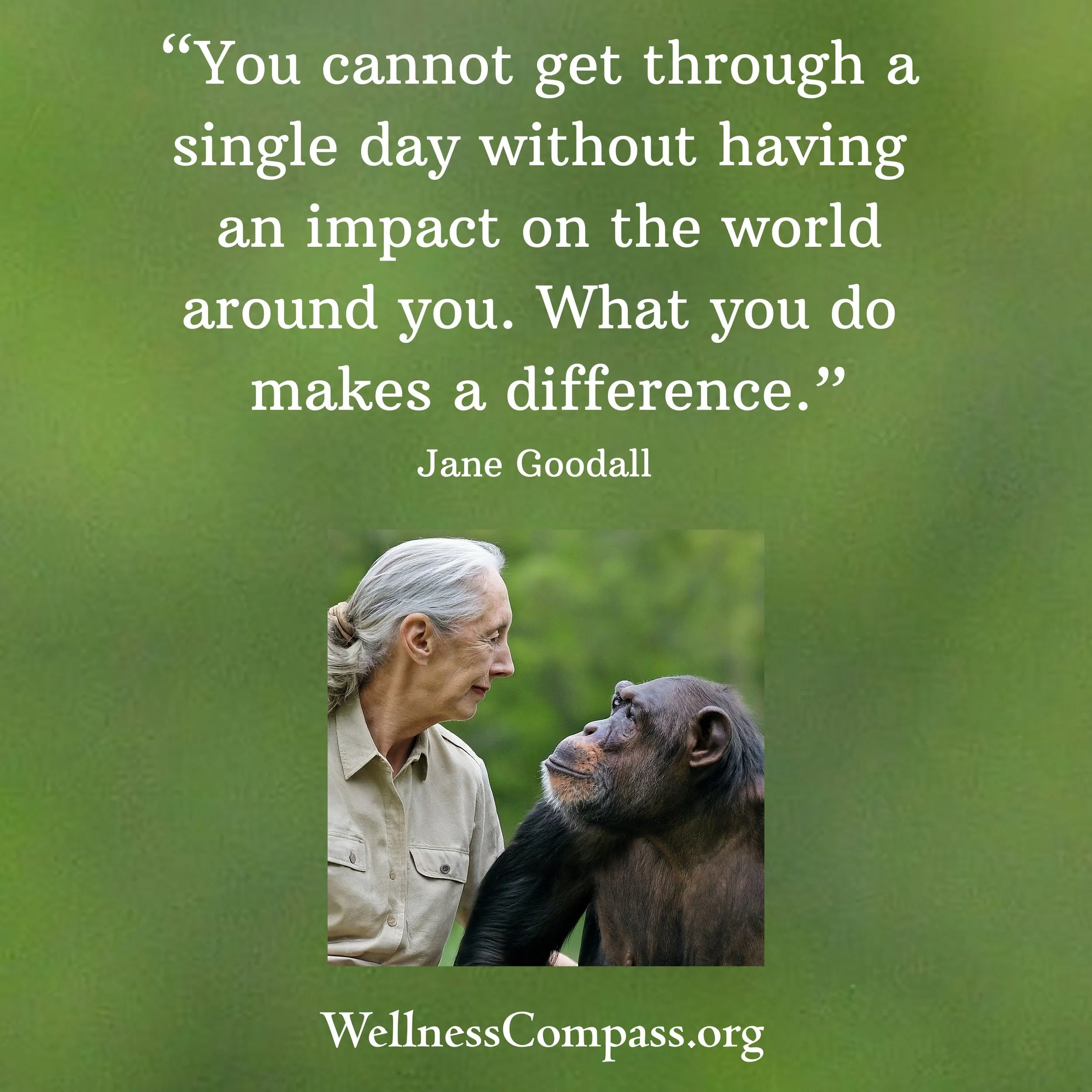
Each of our four Wellness Compass Points this week is a quote from scientist Dr. Jane Goodall, who passed away this week at the age of ninety-one. She will be remembered for many things, but probably most often for the way her scientific curiosity and her work with chimpanzees in the forests of Gombe remind us of the interconnectedness of all life. As therapists who think and practice systemically, we are especially grateful for her teachings about how all of life is an interconnected web and that every action we take in the world has a profound impact on all beings. 

1. “The greatest danger to our future is apathy.”

“Am I really making a positive difference in the world?” is a question that any of us may ask ourselves from time to time. There is a lot that needs our attention in our personal and collective lives, and it is easy to feel overwhelmed. The opposite of apathy is hope—not naive optimism, but a disciplined choice to keep showing up as a force for good in the world. 

2. “Lasting change is a series of compromises. And compromise is all right, as long as your values don’t change.”

Too often, compromise is viewed as a sign of weakness.  Remembering that we are all interconnected with all other living organisms helps us realize that compromise is always necessary to achieve the greater good. There is almost always more that unites than divides us. Note that her quote does not ask us to compromise our core values, but to hold true to them with kindness, humility, and respect. None of us possesses all the wisdom. 

3. “What you do makes a difference, and you have to decide what kind of difference you want to make.”

During the pandemic, we wrote about how the question wasn’t Are we contagious?” but rather “What are we contagious with?” Our emotional and spiritual energy is always contagious to those we interact with—either positively or negatively. We all make a difference —the question is, “What kind of difference do we want to make in the world?”.

4. “You cannot get through a single day without having an impact on the world around you. What you do makes a difference.”

Here, Dr. Goodall reminds us always to be aware of the impact our actions and words have on ourselves and those around us. This quote brings to mind two quotes from our Wellness Compass Initiative: “The grass is greener where you water it,” and “Whatever we pay attention to, is what will grow.”

Three Questions for Making It Personal

1. Does one of these quotes particularly speak to you? If so, why, and what might you do to put the wisdom of that quote into action?

2. Do you struggle with apathy? If so, what’s one thing you can do to help you recover a sense of hope? 

3. Is there a situation in your life right now where an openness to compromise might serve the greater good?


Subscribe Now to Weekly Words of Wellness:

Click the button below to signup for the e-mail version of Weekly Words of Wellness. This weekly article can be shared with your community electronically and/or used for group discussion.

You can unsubscribe at any time.

Sign Up